Choosing a new water heater can feel like navigating a maze, especially when faced with seemingly similar options like 40-gallon and 50-gallon tanks. You might wonder if those extra ten gallons truly make a significant difference for your household. The right choice is more than just about capacity; it’s about matching the unit to your family’s daily hot water demands, energy consumption goals, and available space. An undersized tank means cold showers and frustration, while an oversized one wastes energy heating water you don’t use. This guide will meticulously break down the differences between 40-gallon and 50-gallon water heaters, helping you determine which option offers the ideal blend of comfort, efficiency, and cost-effectiveness for your unique home.
Understanding Water Heater Capacity: 40-Gallon vs. 50-Gallon
When we talk about water heater capacity, we refer to the total volume of hot water the tank can store at any given time. This stored hot water is what’s readily available for your household needs, from showers and laundry to dishwashing. The difference between a 40-gallon and a 50-gallon tank is precisely ten gallons of storage. While this might seem like a small increment, it can have substantial implications for households with varying hot water usage patterns and family sizes.
A 40-gallon water heater is designed to hold up to 40 gallons, typically sufficient for smaller households. A 50-gallon unit, on the other hand, provides an additional 10 gallons, offering greater reserve for homes with higher demands. This primary distinction in storage capacity is the foundation for understanding which tank size will best serve your home’s hot water requirements, influencing everything from recovery time to energy consumption.
Who Needs a 40-Gallon Water Heater?
A 40-gallon water heater is often the most economical and practical choice for specific household profiles. Its smaller capacity means it heats less water, which can translate to lower overall energy consumption if matched correctly with demand. This size is particularly well-suited for smaller living spaces and households with limited hot water needs.
Ideal Household Size and Usage
The 40-gallon tank is typically recommended for:
- Individuals or Couples: Homes with 1-2 occupants who have moderate hot water usage.
- Small Households with Low Peak Demand: Even a family of three might find a 40-gallon tank sufficient if hot water usage is staggered and not concentrated during peak hours (e.g., morning showers, dishwashing, and laundry happening at different times).
- Homes with Energy Efficiency Goals: For those who prioritize minimal energy use and don’t require large volumes of hot water, a 40-gallon unit can be more energy-efficient than an oversized tank.
|
Our Picks for the Best Water Heater in 2026
As an Amazon Associate I earn from qualifying purchases.
|
||
| Num | Product | Action |
|---|---|---|
| 1 | Immersion Water Heater Electric, 2000W Portable Water Heater with 304 S S Guard & LCD Thermometer, Fast Heating Bucket Heater, Ideal for Small Bucket Bathtub, Small Pool, Home Camping Outdoor Use |

|
| 2 | Amazon Basics Electric Kettle with Glass Carafe for Tea and Coffee, BPA-Free, Fast Boiling, Auto Shut-Off, 1 Liter, 1500W, Glass and Steel |
|
| 3 | Portable Immersion Water Heater 1800W 120V, Electric Heater for Buckets, Bathtubs and Mini Pools, Submersible Design with Thermostat, Real Time Temperature Display and Dry Burn Protection |
|
| 4 | Zojirushi Micom Water Boiler and Warmer (135 oz. / 4L, Silver) |
|
| 5 | Cosori Electric Kettle, No Plastic Contact With Water, Wide Mouth For Easy Cleaning, Auto Shut Off, 1.7L Tea Kettle & Hot Water Boiler, Water Heater & Teapot, Borosilicate Glass, Black, 1500W |
|
| 6 | Chefman Electric Kettle, 1.8L 1500W, Hot Water Boiler, Removable Lid for Easy Cleaning, Auto Shut Off, Boil-Dry Protection, Stainless Steel Filter, BPA Free, Borosilicate Glass Electric Tea Kettle |
|
| 7 | Amazon Basics Electric Kettle with Glass Carafe for Tea and Coffee, BPA-Free, Fast Boiling, Auto Shut-Off, 1.7 Liter, 1500W, Black and Silver |
|
| 8 | Portable Water Heater 2000W, Pool Heater - Immersion Heater with Digital Thermometer, Upgraded Magnesium Oxide Heating for Fast Heating, for Small Pools, Bathtubs, Buckets, Tanks |
|
| 9 | Amazon Basics Electric Stainless Steel Kettle for Tea and Coffee, BPA-Free, Fast Boiling, Auto Shut-Off, 1.7 Liter, 1500W, Black and Silver |
|
| 10 | OVENTE Electric Kettle, 1.7L Fast Boiling Water Heater for Coffee or Tea, BPA Free with Water Level Gauge, Auto Shut-Off, Boil-Dry Protection, Indicator Light and Removable Filter, White KP72W |
|
Space Considerations
One of the significant advantages of a 40-gallon water heater is its more compact footprint. These tanks are generally shorter and have a smaller diameter than their 50-gallon counterparts. This makes them an excellent fit for:
- Tight Utility Closets: Where space is at a premium, a 40-gallon tank can fit more comfortably.
- Small Basements or Alcoves: Limited installation areas benefit from the reduced dimensions.
- Replacement of Older Units: Many older homes had smaller water heaters, making a 40-gallon tank an easier, more straightforward replacement.
Pros and Cons of a 40-Gallon Water Heater
Pros:
- Lower Initial Cost: Generally less expensive to purchase and install.
- Compact Size: Fits better in smaller spaces.
- Lower Standby Heat Loss: Heats a smaller volume of water, potentially reducing energy waste when hot water isn’t being used.
- Faster Initial Heat-Up: Due to the smaller volume, it can sometimes heat the water more quickly.
Cons:
- Limited Hot Water Supply: Can run out of hot water quickly during peak usage, leading to cold showers.
- Not Suitable for Larger Families: Will struggle to meet the demands of 3 or more people with simultaneous hot water needs.
- Frequent Reheating: May cycle more often in homes with slightly higher demand, potentially wearing out components faster.
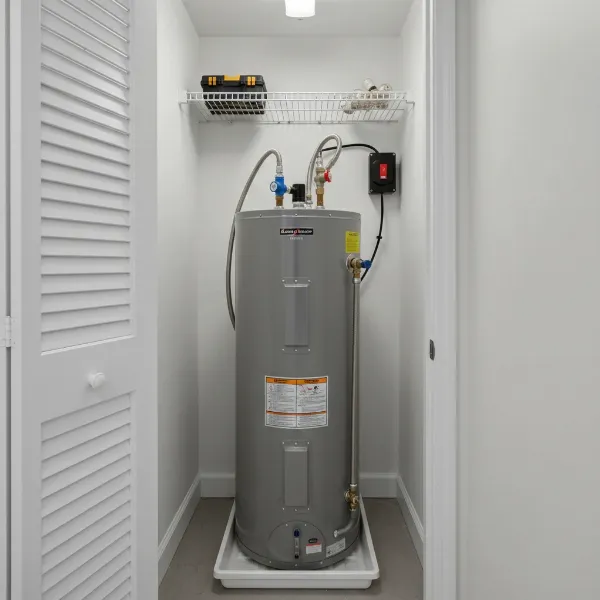 A compact 40-gallon water heater installed in a small utility closet, emphasizing its space-saving benefits.
Who Benefits Most from a 50-Gallon Water Heater?
The 50-gallon water heater offers a greater hot water reserve, making it a popular choice for households that require a more robust and reliable supply. This additional capacity provides a buffer, ensuring consistent hot water even during periods of high demand.
Ideal Household Size and Usage
A 50-gallon water heater is frequently recommended for:
- Medium to Larger Families: Typically suitable for 3-4 people, and sometimes even 5+ people if hot water usage is moderate or spread out.
- Homes with Multiple Bathrooms: Essential for households where more than one shower might be running simultaneously.
- High Peak Demand: If your family frequently uses hot water for multiple tasks at the same time (e.g., showering, running a dishwasher, and doing laundry), the extra capacity prevents running out.
- Guest Frequency: Ideal for homes that regularly host guests, providing ample hot water without interruption.
Comfort and Convenience
The primary benefit of a 50-gallon tank is the enhanced comfort and convenience it offers. With 10 extra gallons, you’re less likely to experience a sudden loss of hot water in the middle of a shower or while running appliances. This added buffer significantly improves the overall hot water experience, especially in busy households. It minimizes waiting times during peak usage hours, ensuring everyone gets a hot shower without compromise.
Pros and Cons of a 50-Gallon Water Heater
Pros:
- Ample Hot Water Supply: Provides sufficient hot water for larger families and multiple simultaneous uses.
- Reduced Risk of Running Out: Less chance of cold showers during peak demand.
- Better for Multiple Appliances: Can easily handle a dishwasher, washing machine, and showers running concurrently.
- Potential for Better Efficiency (for high demand): If consistently meeting high demand without constantly reheating a smaller tank, it can be more efficient in providing uninterrupted hot water.
Cons:
- Higher Initial Cost: More expensive to purchase and install than a 40-gallon unit.
- Larger Footprint: Requires more installation space, which can be an issue in smaller homes.
- Increased Standby Heat Loss (if oversized): If the tank is too large for your actual needs, it will waste energy heating water that isn’t used, leading to higher operational costs.
- Slightly Longer Heat-Up Time: Heating a larger volume of water can take a bit more time initially compared to a smaller tank.
Key Factors to Consider When Choosing Water Heater Tank Size
Making the right decision between a 40-gallon and 50-gallon water heater involves a comprehensive assessment of your household’s specific needs and living conditions. It’s not just about raw capacity but also about how efficiently that capacity serves your daily life.
Household Size and Hot Water Usage
This is perhaps the most critical factor. How many people live in your home, and what are their hot water habits?
- 1-2 People: A 40-gallon tank is generally sufficient, especially if hot water use is staggered.
- 2-3 People: This is often the grey area. A 40-gallon might work for low-demand households, but a 50-gallon offers greater peace of mind and comfort, particularly if there’s any overlap in hot water usage.
- 3-4 People: A 50-gallon tank is usually the minimum recommended size to comfortably meet demand, especially with multiple showers or appliances running.
- 5+ People: Consider a 50-gallon or even larger, depending on the number of bathrooms and appliances.
Consider your peak hour demand – the time when your family uses the most hot water. Do multiple family members shower back-to-back in the morning? Do you run the dishwasher and laundry simultaneously? These scenarios push a water heater to its limits, and a larger tank provides a crucial buffer.
First Hour Rating (FHR)
The First Hour Rating (FHR) is a critical metric often overlooked. It indicates the total number of gallons of hot water the heater can supply in one hour, starting with a full tank. This rating accounts for both the tank’s storage capacity and its ability to recover (reheat) water.
- A 40-gallon tank might have an FHR around 50-60 gallons, while a 50-gallon tank could have an FHR closer to 70-80 gallons or more.
- Always check the FHR when comparing models, as a highly efficient 40-gallon unit might outperform a less efficient 50-gallon unit in terms of available hot water during peak demand. The FHR gives a clearer picture of real-world performance than just tank size alone.
Space Availability
Measure your installation area carefully. Water heaters have specific dimensions for height, width, and depth.
- 40-Gallon: Typically shorter and narrower, making it easier to fit into confined spaces like closets, under stairs, or in smaller utility rooms.
- 50-Gallon: Requires more generous clearance. Remember to account for plumbing connections at the top, the temperature and pressure relief valve on the side, and a drain pan underneath. Ensure there’s enough room for maintenance access.
Energy Efficiency and Operating Costs
The Energy Factor (EF) is a measure of a water heater’s overall energy efficiency, considering how much hot water is produced per unit of fuel consumed over a typical day.
- Standby Heat Loss: Larger tanks have more surface area, potentially leading to greater standby heat loss if not well-insulated or if the tank is oversized for the household’s actual needs.
- Matching Capacity to Demand: An appropriately sized tank is crucial for efficiency. An oversized 50-gallon tank in a small household will waste energy by heating excess water that goes unused, while an undersized 40-gallon tank in a large household will constantly cycle, also leading to inefficiency and premature wear.
- Fuel Type: Electric heaters generally take longer to recover than gas models after significant hot water draws. This recovery rate influences overall efficiency, especially during high-demand periods.
Initial Investment vs. Long-Term Savings
While a 50-gallon water heater typically has a higher upfront cost, consider the long-term value.
- The slight initial increase for a 50-gallon tank might be offset by enhanced comfort and convenience, especially for growing families or those with high hot water demands.
- However, if a 40-gallon tank perfectly meets your needs, choosing the larger size means unnecessary initial expense and potentially higher ongoing operational costs due to standby heat loss.
| Feature | 40-Gallon Water Heater | 50-Gallon Water Heater |
|---|---|---|
| Ideal For | 1-2 people, small households, limited space | 3-4+ people, active families, multiple bathrooms |
| Capacity | 40 gallons | 50 gallons |
| Initial Cost | Lower | Higher |
| Operating Cost | Potentially lower (if accurately sized) | Potentially higher (if oversized), or lower (if perfectly matched to high demand) |
| Space Req. | More compact, fits in tight spaces | Larger footprint, requires generous installation space |
| Hot Water Supply | Good for low to moderate use | Ample, handles peak demand well |
| FHR | Generally lower (e.g., 50-60 gallons/hour) | Generally higher (e.g., 70-80+ gallons/hour) |
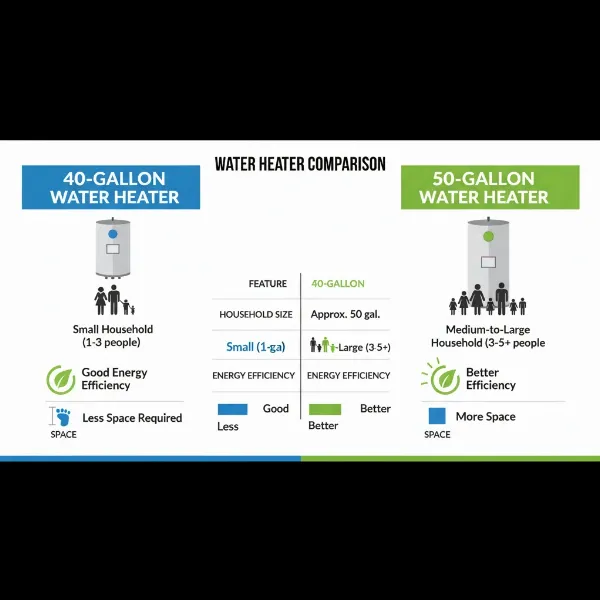 A visual comparison of 40-gallon and 50-gallon water heater benefits, showing family size and efficiency.
Optimizing Your Water Heater’s Performance
Regardless of whether you choose a 40-gallon or 50-gallon water heater, proper usage and maintenance are key to maximizing its efficiency, extending its lifespan, and ensuring a consistent supply of hot water. Regular care helps prevent common issues and ensures your investment continues to perform optimally.
Regular Cleaning and Inspection
Sediment buildup in the tank can reduce efficiency and lead to premature failure.
- Flush the Tank Annually: Drain a few gallons from the tank to remove sediment. This helps maintain heating efficiency and prevents clogs.
- Inspect the Anode Rod: The anode rod sacrifices itself to prevent corrosion of the tank. Have it checked every 3-5 years and replaced if significantly corroded.
- Check for Leaks: Periodically inspect the tank and connections for any signs of leaks or corrosion. Early detection can prevent major water damage.
Temperature Setting
Setting the thermostat too high not only wastes energy but can also be a safety hazard.
- Optimal Temperature: Most experts recommend setting your water heater to 120°F (49°C). This temperature is hot enough for most household needs, helps prevent scalding, and reduces energy consumption and mineral buildup.
- Lower During Vacations: If you’re going away for an extended period, consider lowering the thermostat or putting it on “vacation mode” to save energy.
Insulation and Safety
Ensuring proper insulation and safety measures are in place can significantly impact efficiency and peace of mind.
- Insulate Pipes: Insulating the hot water pipes closest to the heater can reduce heat loss as water travels to your fixtures.
- Insulate the Tank: If your water heater is older or in an unconditioned space, an insulation blanket can reduce standby heat loss. However, newer, high-efficiency models often have sufficient factory insulation.
- Test the T&P Valve: The temperature and pressure relief (T&P) valve is a crucial safety device. Test it annually (carefully, as hot water will discharge) to ensure it’s not stuck. If you’re unsure, consult a professional.
“Choosing the right water heater size is a long-term investment in your home’s comfort and efficiency. It’s about accurately predicting your family’s hot water rhythm, not just a simple headcount.” – John Smith, Master Plumber and Water Heater Specialist
Conclusion
Deciding between a 40-gallon and a 50-gallon water heater ultimately comes down to a nuanced understanding of your household’s specific hot water demands, available space, and budget. While a 40-gallon unit often suffices for smaller families or individuals with conservative usage, offering a more compact footprint and lower initial cost, a 50-gallon tank provides a significant advantage for larger households or those with high peak-hour demands, ensuring a consistent supply of hot water for multiple uses.
By carefully considering factors such as household size, First Hour Rating, energy efficiency, and installation space, you can make an informed decision that will lead to years of reliable hot water. Remember, the goal is to find the perfect balance that prevents cold showers without wasting energy on an oversized system. What are your family’s daily hot water habits, and how will they influence your final choice?
Frequently Asked Questions
Is a 40-gallon water heater enough for a family of 4?
A 40-gallon water heater is generally not sufficient for a family of four, especially if hot water is used simultaneously for showers, laundry, or dishwashing. It is typically recommended for 1-2 people, or possibly 2-3 with very low and staggered hot water usage. A 50-gallon or larger tank would be more appropriate for a family of four to ensure comfort and avoid running out of hot water during peak times.
How much bigger is a 50-gallon water heater than a 40-gallon?
While both are similar in overall design, a 50-gallon water heater will be noticeably larger than a 40-gallon unit. It will have a larger diameter and/or be taller to accommodate the extra 10 gallons of storage capacity. You should always check the specific dimensions of both models you are considering, as sizes can vary slightly by manufacturer and fuel type (e.g., gas vs. electric).
Does a 50-gallon water heater use more electricity than a 40-gallon?
A 50-gallon water heater typically uses more electricity than a 40-gallon unit. This is because it has a larger volume of water to heat and maintain at temperature, leading to potentially higher standby heat loss if not well-insulated. However, if a 40-gallon tank is undersized for a household’s demand, it might cycle more frequently, also consuming more energy. The most efficient choice depends on matching the tank size precisely to your household’s hot water usage patterns.
Can I replace a 40-gallon water heater with a 50-gallon?
Yes, you can generally replace a 40-gallon Water Heater with a 50-gallon unit, provided you have adequate installation space. You must measure the height, width, and depth of your available area carefully, accounting for all plumbing connections, the temperature and pressure relief valve, and a drain pan. Ensure there’s sufficient clearance for installation and future maintenance. It’s also wise to check if your existing plumbing and electrical or gas lines can support the larger unit, and consult a professional for proper installation.