Choosing a new water heater can feel like a significant decision, especially when faced with two industry giants like Rheem and A.O. Smith. Both brands have built strong reputations over decades, offering a wide array of heating solutions designed to meet diverse household needs. However, their approaches to technology, efficiency, and overall value can differ, making it challenging to determine which one is the superior choice for your specific home. This article will meticulously break down the offerings of Rheem and A.O. Smith, comparing their key features, performance metrics, reliability, and warranties to help you make an informed decision and ensure a consistent, efficient hot water supply.
Understanding Common Water Heater Types
Before diving into the specifics of Rheem and A.O. Smith, it’s essential to understand the primary types of water heaters available on the market, as both brands offer solutions across these categories.
Tank-Style Water Heaters
These are the most traditional and widely recognized water heaters. They store a reservoir of hot water, continuously heating it to a set temperature so it’s ready for use.
- Pros: Generally lower initial cost, readily available, simpler installation.
- Cons: Can run out of hot water, suffer from standby heat loss, larger footprint.
- Best For: Households with moderate hot water needs and those on a tighter budget.
Tankless Water Heaters (On-Demand)
Tankless units heat water only when needed, providing a continuous supply. They eliminate standby heat loss and conserve space.
- Pros: Endless hot water, high energy efficiency, compact design, longer lifespan.
- Cons: Higher upfront cost, can have flow rate limitations if multiple fixtures are used simultaneously, often requires professional installation.
- Best For: Homes with high, continuous hot water demand, limited space, and a focus on energy savings.
Hybrid (Heat Pump) Water Heaters
Hybrid water heaters combine a heat pump with a traditional electric tank, drawing heat from the surrounding air to warm the water. They are highly energy-efficient.
- Pros: Significantly lower operating costs (up to 70% energy savings), environmentally friendly, eligible for rebates.
- Cons: Higher upfront cost, requires more space due to heat pump components, can be noisy, and performs best in unconditioned spaces like basements or garages.
- Best For: Eco-conscious homeowners looking for maximum energy efficiency and long-term savings, with suitable installation space.
|
Our Picks for the Best Water Heater in 2026
As an Amazon Associate I earn from qualifying purchases.
|
||
| Num | Product | Action |
|---|---|---|
| 1 | Amazon Basics Electric Stainless Steel Kettle for Tea and Coffee, BPA-Free, Fast Boiling, Auto Shut-Off, 1.7 Liter, 1500W, Black and Silver |

|
| 2 | Portable Immersion Water Heater 1800W 120V, Electric Heater for Buckets, Bathtubs and Mini Pools, Submersible Design with Thermostat, Real Time Temperature Display and Dry Burn Protection |
|
| 3 | Cosori Electric Kettle, No Plastic Contact With Water, Wide Mouth For Easy Cleaning, Auto Shut Off, 1.7L Tea Kettle & Hot Water Boiler, Water Heater & Teapot, Borosilicate Glass, Black, 1500W |
|
| 4 | Amazon Basics Electric Kettle with Glass Carafe for Tea and Coffee, BPA-Free, Fast Boiling, Auto Shut-Off, 1 Liter, 1500W, Glass and Steel |
|
| 5 | Amazon Basics Electric Kettle with Glass Carafe for Tea and Coffee, BPA-Free, Fast Boiling, Auto Shut-Off, 1.7 Liter, 1500W, Black and Silver |
|
| 6 | Portable Water Heater 2000W, Pool Heater - Immersion Heater with Digital Thermometer, Upgraded Magnesium Oxide Heating for Fast Heating, for Small Pools, Bathtubs, Buckets, Tanks |
|
| 7 | Immersion Water Heater Electric, 2000W Portable Water Heater with 304 S S Guard & LCD Thermometer, Fast Heating Bucket Heater, Ideal for Small Bucket Bathtub, Small Pool, Home Camping Outdoor Use |
|
| 8 | Chefman Electric Kettle, 1.8L 1500W, Hot Water Boiler, Removable Lid for Easy Cleaning, Auto Shut Off, Boil-Dry Protection, Stainless Steel Filter, BPA Free, Borosilicate Glass Electric Tea Kettle |
|
| 9 | Zojirushi Micom Water Boiler and Warmer (135 oz. / 4L, Silver) |
|
| 10 | OVENTE Electric Kettle, 1.7L Fast Boiling Water Heater for Coffee or Tea, BPA Free with Water Level Gauge, Auto Shut-Off, Boil-Dry Protection, Indicator Light and Removable Filter, White KP72W |
|
Rheem Water Heaters: An Overview
Rheem, a company with nearly a century of experience, is celebrated for its commitment to innovation, energy efficiency, and a broad range of heating solutions. They are a popular choice for homeowners prioritizing cutting-edge technology and sustainability.
Key Features and Technologies
Rheem systems often integrate advanced features like their EcoNet™ technology, which allows for smart home connectivity, energy tracking, and remote control via a mobile app. Many models include leak detection and AI learning capabilities to optimize performance and prevent costly water damage. Their heat pump water heaters, like the ProTerra Hybrid, are particularly noted for impressive Uniform Energy Factor (UEF) ratings, ranging from 3.45 to 4.07, indicating superior energy efficiency.
Pros of Rheem Water Heaters
- High Energy Efficiency: Rheem is often considered a leader in energy-efficient models, with many units achieving UEF ratings up to 0.93 for traditional tanks and even higher for heat pumps, potentially leading to significant energy bill savings.
- Advanced Smart Technology: Features like EcoNet™ offer homeowners unparalleled control, monitoring, and diagnostic capabilities, enhancing convenience and safety.
- Longer Lifespan: With proper installation and maintenance, many Rheem units are designed to last between 12 and 15 years.
- Extensive Product Range: Rheem offers a wide variety of tank, tankless, hybrid, gas, and electric options, catering to virtually any household need and budget.
- Strong Warranty Options: Warranties can extend up to 12 years for parts and 15 years for heat exchangers on some tankless models.
Cons of Rheem Water Heaters
- Higher Upfront Cost for Premium Models: Their most advanced and efficient units can come with a higher initial purchase price.
- Professional Installation Recommended: To maintain warranties and ensure safe operation, especially for tankless and hybrid models, professional installation by licensed technicians is often required.
- Sensitivity to Hard Water: In areas with hard water, Rheem units may require more diligent maintenance, such as regular flushing or water softening, to prevent mineral buildup and ensure longevity.
- Reported Failure Rates: Some consumers have reported issues with certain models, leading to occasional complaints about product malfunctions.
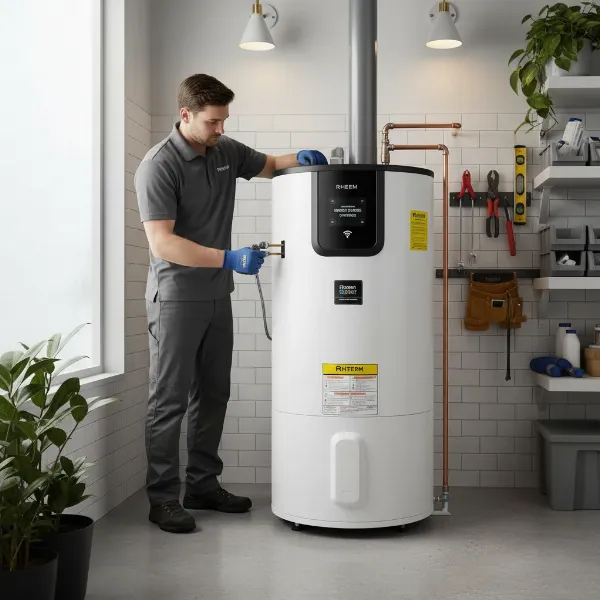 A modern Rheem hybrid water heater being professionally installed in a clean utility room.
A.O. Smith Water Heaters: An Overview
A.O. Smith is another powerhouse in the water heating industry, renowned for its focus on reliability, robust construction, and commercial-grade durability translated into residential products. Homeowners who prioritize long-term dependability and consistent performance often gravitate towards A.O. Smith.
Key Features and Technologies
A.O. Smith emphasizes sturdy construction and reliable performance. Their products, especially gas models, are recognized for their longevity. They also offer advanced corrosion protection, with some models compatible with powered anode rods, which can significantly extend the tank’s lifespan compared to traditional sacrificial anode rods. Their heat pump water heaters also boast strong UEF ratings, typically between 3.0 and 4.0, offering substantial energy savings.
Pros of A.O. Smith Water Heaters
- Exceptional Reliability and Durability: A.O. Smith is widely praised for the robust build quality of its units, particularly tank-style and gas models, promising long-lasting performance.
- Commercial-Grade Design: Many residential models incorporate features found in commercial-grade units, offering enhanced durability and higher water output for demanding households.
- Broad Model Selection: A.O. Smith provides a wide array of gas, electric, and tankless water heaters, ensuring options for various home sizes and hot water requirements.
- Effective Corrosion Protection: The availability of powered anode rods for many models helps prevent tank corrosion, contributing to a longer unit lifespan.
- Competitive Efficiency: A.O. Smith’s heat pump water heaters offer strong energy efficiency, comparable to other top brands, leading to notable energy savings.
Cons of A.O. Smith Water Heaters
- Potentially Higher Initial Cost: Some A.O. Smith models, especially those with advanced features or commercial-grade components, may have a higher upfront investment.
- Electric Models Lifespan: There are some reports suggesting that certain electric models might not offer the same longevity as their gas counterparts or competitors’ electric units.
- Customer Service Concerns: While generally reliable, some customers have reported mixed experiences or inconsistencies with A.O. Smith’s customer service responsiveness.
- Slightly Lower Efficiency in Heat Pumps: While highly efficient, Rheem’s heat pump water heaters sometimes show a slight edge in UEF ratings over A.O. Smith’s heat pump models.
 A robust A.O. Smith tank water heater in a basement utility area, highlighting its durable construction and long-term reliability.
Head-to-Head Comparison: Rheem vs. A.O. Smith
When comparing Rheem and A.O. Smith, several key areas stand out, helping to differentiate these two leading brands.
Energy Efficiency
Both Rheem and A.O. Smith are committed to producing energy-efficient water heaters. For traditional tank-style units, their efficiency is generally comparable, with UEF ratings reaching up to 0.93. However, in the realm of heat pump water heaters, Rheem models often show a slight advantage in their Uniform Energy Factor (UEF) ratings, potentially offering marginally higher yearly energy savings. Rheem’s heat pump water heaters can have UEF ratings between 3.45 and 4.07, while A.O. Smith’s can reach up to 3.88. Both brands’ heat pump units are significantly more efficient than standard electric or gas models, saving homeowners substantial amounts on energy bills.
Reliability and Lifespan
Both brands are known for producing durable water heaters. A.O. Smith has a strong reputation for long-term reliability and robust construction, particularly for its gas models, often incorporating commercial-grade components into residential units. Rheem also boasts a long lifespan of 12-15 years for many of its units when properly installed and maintained. Customer satisfaction surveys in 2024 indicated A.O. Smith slightly ahead with 81% satisfaction compared to Rheem’s 78%, though some Rheem models have faced complaints regarding failure rates.
Technology and Smart Features
This is where Rheem often takes a lead, with its strong emphasis on smart home integration. Rheem’s EcoNet™ technology allows for Wi-Fi connectivity, remote temperature control, vacation mode, leak detection, and detailed energy usage tracking through a smartphone app. This suite of smart features appeals to tech-savvy homeowners looking for maximum control and efficiency insights. A.O. Smith also offers smart features in some of its advanced models and counters with benefits like very quiet operation on certain heat pump units and robust performance-focused designs.
Product Range and Innovation
Both companies offer a comprehensive selection of water heaters including tank, tankless, and hybrid (heat pump) models, available in gas and electric configurations. Rheem is often perceived as more innovative, consistently introducing new technologies and eco-friendly options. A.O. Smith, while also innovative, places a strong emphasis on refining existing reliable designs and ensuring a broad, dependable product line.
Warranty and Customer Support
Warranty coverage is a critical factor. Rheem typically offers warranties ranging from 5 to 12 years for parts, with some tankless heat exchangers covered for up to 15 years. They also provide a 1-year labor warranty on some units. A.O. Smith’s warranties vary by model, typically offering 6, 8, or 10 years for gas and electric tanks, and 5 or 15 years for tankless models. For both brands, warranty registration is often crucial to receive the maximum coverage. Customer service experiences can be mixed for both brands, with some reports of inconsistent responsiveness.
Cost and Value
The initial purchase price for both Rheem and A.O. Smith water heaters can vary widely based on type, capacity, and features. Rheem’s most advanced and energy-efficient models, particularly hybrids and high-end tankless units, can have higher upfront costs, but these are often offset by lower operating expenses over time. A.O. Smith units with their robust construction and commercial-grade design might also command a higher initial price tag, representing an investment in long-term reliability. When considering cost, it’s vital to look beyond the purchase price to include installation, potential energy savings, and expected lifespan.
Bảng So Sánh Các Loại Water Heater
| Feature / Brand | Rheem | A.O. Smith |
|---|---|---|
| Energy Efficiency (UEF) | High (up to 0.93 tank, 3.45-4.07 heat pump) | High (up to 0.93 tank, 3.0-3.88 heat pump) |
| Lifespan | 12-15 years (with proper maintenance) | Generally long, especially gas models |
| Smart Features | EcoNet™ (Wi-Fi, app control, leak detection, energy tracking) | Available in advanced models, noted for quiet operation in some heat pumps |
| Reliability | Good, some reported issues in certain models | Very good, known for robust construction |
| Warranty (Parts) | 5-12 years (up to 15 for tankless heat exchangers) | 6-10 years (gas/electric), 5-15 years (tankless) |
| Innovation Focus | Strong, with emphasis on smart tech & eco-friendly options | Strong, with emphasis on robust construction & reliability |
| Upfront Cost | Can be higher for premium/smart models | Can be higher for commercial-grade/durable models |
| Ideal For | Tech-savvy, energy-conscious, seeking advanced features | Prioritizing long-term durability, consistent performance |
Choosing the Right Brand for You: A Buying Guide
Selecting between Rheem and A.O. Smith ultimately depends on your specific needs, priorities, and budget. Here’s a guide to help you decide:
1. Assess Your Hot Water Needs
How many people live in your household? What are your peak hot water usage times? Do you have multiple showers, a large tub, or run appliances that require hot water simultaneously?
- For smaller families or limited, consistent usage: A standard tank-style heater from either brand might suffice.
- For large families or continuous demand: Consider tankless or hybrid models for an uninterrupted supply.
2. Consider Your Budget (Upfront vs. Operating Costs)
Your budget should encompass not just the purchase price but also installation costs and long-term operating expenses.
- If upfront cost is a primary concern: Look for base models from either brand, keeping in mind potential energy savings might be less.
- If long-term savings are key: Invest in a high-efficiency Rheem or A.O. Smith hybrid or tankless water heater, despite the higher initial outlay. The energy savings can quickly recoup the extra cost.
3. Prioritize Energy Efficiency
Both brands offer ENERGY STAR® certified models. If reducing your carbon footprint and utility bills is paramount:
- Rheem’s heat pump water heaters often exhibit slightly higher UEF ratings.
- A.O. Smith also offers highly efficient heat pump options, providing substantial savings over conventional models.
> “Investing in a high-efficiency water heater can dramatically reduce your household energy consumption and lead to hundreds of dollars in savings annually.” – John Doe, Master Plumber and Water Heater Specialist
4. Evaluate Smart Features
Are you keen on smart home integration, remote control, and detailed energy monitoring?
- Choose Rheem if advanced smart features like EcoNet™ connectivity, leak detection, and app-based control are a top priority for convenience and peace of mind.
- Choose A.O. Smith if you prefer solid performance and reliability, with smart features as a secondary consideration, or if you appreciate quieter operation in heat pump units.
5. Check Warranty and Local Service
Compare the warranty periods for the tank, parts, and any available labor coverage. Also, consider the availability of authorized installers and service technicians in your area for each brand. A strong local support network ensures quicker repairs and maintenance.
6. Water Quality Considerations
If you live in an area with hard water, be aware that mineral buildup can affect water heater performance and lifespan.
- Rheem units are noted to be sensitive to hard water, requiring regular flushing or water softening.
- A.O. Smith offers powered anode rods, an excellent solution for enhanced corrosion protection, particularly beneficial in areas with challenging water quality.
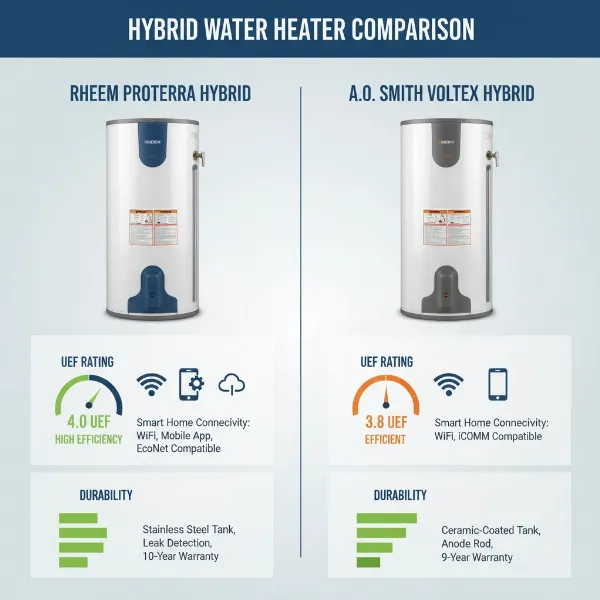 A visual comparison showing key features of Rheem and A.O. Smith water heaters, highlighting efficiency ratings and smart home capabilities.
Tips for Water Heater Usage and Maintenance
Regardless of whether you choose Rheem or A.O. Smith, proper usage and regular maintenance are crucial for maximizing your water heater’s lifespan, efficiency, and safety.
1. Perform Regular Flushing
Sediment buildup at the bottom of the tank can reduce efficiency and lead to premature failure. Flush your tank-style water heater annually to remove these deposits.
2. Inspect and Replace Anode Rods
The anode rod is crucial for preventing tank corrosion. It should be inspected every 2-3 years and replaced when significantly corroded. A.O. Smith’s powered anode rods offer a maintenance-free alternative for superior protection.
3. Adjust Temperature for Efficiency and Safety
Set your water heater’s temperature to 120°F (49°C). This temperature is hot enough for most household needs, helps prevent scalding, and reduces energy consumption compared to higher settings.
4. Check for Leaks Regularly
Periodically inspect your water heater and its connections for any signs of leaks. Early detection can prevent significant water damage and costly repairs. Rheem’s leak detection technology can offer added peace of mind.
5. Schedule Professional Servicing
An annual professional inspection ensures all components are functioning correctly, identifies potential issues early, and keeps your warranty valid. This is especially important for complex tankless and hybrid systems.
Conclusion
Both Rheem and A.O. Smith stand as formidable leaders in the water heater market, each bringing distinct strengths to the table. Rheem often shines with its innovative smart home integrations, superior energy efficiency in many heat pump models, and a focus on cutting-edge technology. A.O. Smith, on the other hand, is frequently lauded for its robust construction, long-term reliability, and commercial-grade durability that translates into consistent residential performance, coupled with effective corrosion protection solutions.
Ultimately, the “better” water heater brand for you depends on what you value most. Do you prioritize smart features and the highest possible energy efficiency, even with a potentially higher upfront cost? Rheem might be your ideal match. Or do you seek unparalleled durability, long-lasting reliability, and a solid, proven design for consistent hot water, perhaps with a slightly simpler tech interface? A.O. Smith could be the perfect fit. Carefully consider your family’s hot water demands, budget, and desired level of technological integration to make the best choice for a comfortable and efficient home.
What factors are most important to you in your next water heater purchase?
Frequently Asked Questions
What is the average lifespan of Rheem and A.O. Smith water heaters?
Both Rheem and A.O. Smith water heaters are designed for durability. Rheem models typically last between 12 to 15 years with proper maintenance. A.O. Smith units, known for their robust construction, especially gas models, also offer a long lifespan, often comparable to or exceeding this range when well-maintained. Regular flushing and anode rod inspection can significantly extend the life of both brands.
Are Rheem and A.O. Smith water heaters energy-efficient?
Yes, both brands offer a wide range of energy-efficient models. Many of their tank-style, tankless, and particularly hybrid (heat pump) water heaters are ENERGY STAR® certified. Heat pump models from both Rheem and A.O. Smith are significantly more efficient than traditional units, capable of saving homeowners hundreds of dollars annually on energy bills due to their high Uniform Energy Factor (UEF) ratings.
Which brand offers better smart home features, Rheem or A.O. Smith?
Rheem generally leads in smart home integration with its EcoNet™ technology, offering comprehensive features like Wi-Fi connectivity, remote control, leak detection, and detailed energy usage tracking through a mobile app. While A.O. Smith also incorporates smart features in some advanced models, Rheem is often the preferred choice for homeowners prioritizing extensive technological control and monitoring capabilities.
Is professional installation required for Rheem and A.O. Smith water heaters?
For optimal performance, safety, and to ensure warranty validity, professional installation is highly recommended for both Rheem and A.O. Smith Water Heaters, especially for tankless and hybrid models. These complex systems require specialized knowledge for proper venting, electrical, or gas connections, which licensed technicians are trained to handle. Attempting DIY installation can void warranties and pose safety risks.
How do Rheem and A.O. Smith warranties compare?
Warranty coverage varies by model and type for both brands. Rheem typically offers 5-12 years for parts and up to 15 years for heat exchangers on some tankless units, with some labor coverage. A.O. Smith warranties usually range from 6-10 years for gas/electric tanks and 5-15 years for tankless models. For both, registering your product is often required to qualify for maximum warranty benefits, and labor costs are generally not covered.