Choosing a new water heater can feel like navigating a maze, especially with advanced options like tankless models promising endless hot water and significant energy savings. But even within the tankless category, there’s a crucial distinction to understand: condensing vs. non-condensing. This choice impacts everything from your initial investment and long-term utility bills to installation requirements and environmental footprint. Whether you’re upgrading an old system or installing a new one, understanding these differences is key to ensuring your home enjoys efficient, on-demand hot water for years to come.
Understanding Tankless Water Heaters: An Overview
Tankless water heaters, often called on-demand water heaters, represent a modern approach to domestic hot water supply. Unlike conventional systems that store and continuously heat a large volume of water in a tank, tankless units heat water only when it’s needed. When a hot water tap is opened, cold water flows into the unit, a powerful heating element (gas burner or electric coil) rapidly heats it, and then it’s delivered instantly to your faucet. This ingenious design eliminates standby energy losses associated with traditional tanks, leading to greater energy efficiency and a continuous supply of hot water. Within this innovative technology, two primary types exist: condensing and non-condensing, each offering distinct advantages and considerations for homeowners.
How Condensing Tankless Water Heaters Work
Condensing tankless water heaters are the more energy-efficient of the two types, achieving efficiency ratings often exceeding 90%. Their superior performance stems from an advanced heat recovery system. After the primary heat exchanger heats the water, hot exhaust gases, typically laden with water vapor, are not immediately vented outside. Instead, these gases are directed through a secondary heat exchanger. This additional component extracts latent heat from the exhaust, causing the water vapor within the gases to condense into liquid. This reclaimed heat is then used to pre-heat the incoming cold water, significantly reducing the amount of energy required by the main burner. This process not only boosts efficiency but also cools the exhaust gases considerably before they are expelled.
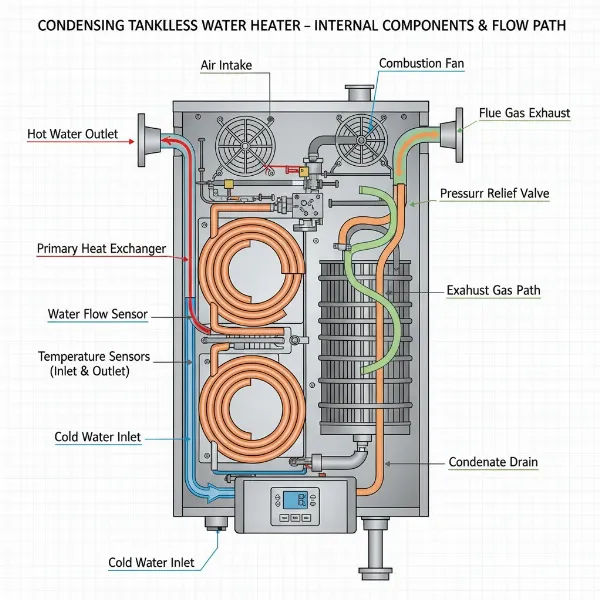 Diagram showing internal workings of a condensing tankless water heater with two heat exchangers.
How Non-Condensing Tankless Water Heaters Work
Non-condensing tankless water heaters operate using a more straightforward mechanism, typically achieving energy efficiency ratings in the range of 80-82%. In these units, cold water enters the system and flows through a single heat exchanger, where it is rapidly heated by a gas burner or electric element. Once the water reaches the desired temperature, it is delivered to your tap. The hot exhaust gases produced during the combustion process are then vented directly outside without any further heat recovery. This simpler design means there is no secondary heat exchanger to capture residual heat or condense water vapor. Consequently, the exhaust gases from non-condensing units are much hotter when released, which influences their venting requirements.
Key Differences: Condensing vs. Non-Condensing Tankless Water Heaters
The fundamental distinctions between condensing and non-condensing tankless water heaters lie in their heat recovery methods, which in turn affect their efficiency, venting, cost, and overall performance. Condensing units utilize a secondary heat exchanger to extract additional heat from exhaust gases, resulting in significantly higher efficiency. This process cools the exhaust down to under 100°F, allowing for the use of less expensive PVC or plastic venting. Conversely, non-condensing units vent hot gases directly, reaching temperatures up to 400°F, necessitating more robust and costly metal venting materials.
| Feature | Condensing Tankless Water Heater | Non-Condensing Tankless Water Heater |
|---|---|---|
| Efficiency (AFUE) | 90% or higher | 80-82% |
| Heat Recovery | Yes (Secondary Heat Exchanger) | No (Single Heat Exchanger) |
| Exhaust Temp. | Below 100°F | Up to 400°F |
| Venting Material | PVC or Plastic (less expensive) | Metal/Stainless Steel (more expensive) |
| Condensate Drain | Required | Not Required |
| Upfront Cost | Higher | Lower |
| Operating Cost | Lower (due to high efficiency) | Higher (due to lower efficiency) |
| Installation | More complex (drainage) | Simpler (unit, but vent costly) |
| Environmental | Reduced emissions | Higher emissions |
Comparative Analysis: Pros and Cons
Choosing between a condensing and non-condensing tankless water heater involves weighing their respective benefits and drawbacks against your specific household needs and priorities. While both offer the convenience of on-demand hot water, their design differences lead to distinct advantages and considerations. Understanding these can help you make an informed decision for your home.
Benefits of Condensing Tankless Water Heaters
|
Our Picks for the Best Water Heater in 2026
As an Amazon Associate I earn from qualifying purchases.
|
||
| Num | Product | Action |
|---|---|---|
| 1 | Amazon Basics Electric Kettle with Glass Carafe for Tea and Coffee, BPA-Free, Fast Boiling, Auto Shut-Off, 1.7 Liter, 1500W, Black and Silver |

|
| 2 | Portable Water Heater 2000W, Pool Heater - Immersion Heater with Digital Thermometer, Upgraded Magnesium Oxide Heating for Fast Heating, for Small Pools, Bathtubs, Buckets, Tanks |
|
| 3 | Chefman Electric Kettle, 1.8L 1500W, Hot Water Boiler, Removable Lid for Easy Cleaning, Auto Shut Off, Boil-Dry Protection, Stainless Steel Filter, BPA Free, Borosilicate Glass Electric Tea Kettle |
|
| 4 | Amazon Basics Electric Stainless Steel Kettle for Tea and Coffee, BPA-Free, Fast Boiling, Auto Shut-Off, 1.7 Liter, 1500W, Black and Silver |
|
| 5 | Portable Immersion Water Heater 1800W 120V, Electric Heater for Buckets, Bathtubs and Mini Pools, Submersible Design with Thermostat, Real Time Temperature Display and Dry Burn Protection |
|
| 6 | OVENTE Electric Kettle, 1.7L Fast Boiling Water Heater for Coffee or Tea, BPA Free with Water Level Gauge, Auto Shut-Off, Boil-Dry Protection, Indicator Light and Removable Filter, White KP72W |
|
| 7 | Cosori Electric Kettle, No Plastic Contact With Water, Wide Mouth For Easy Cleaning, Auto Shut Off, 1.7L Tea Kettle & Hot Water Boiler, Water Heater & Teapot, Borosilicate Glass, Black, 1500W |
|
| 8 | Zojirushi Micom Water Boiler and Warmer (135 oz. / 4L, Silver) |
|
| 9 | Amazon Basics Electric Kettle with Glass Carafe for Tea and Coffee, BPA-Free, Fast Boiling, Auto Shut-Off, 1 Liter, 1500W, Glass and Steel |
|
| 10 | Immersion Water Heater Electric, 2000W Portable Water Heater with 304 S S Guard & LCD Thermometer, Fast Heating Bucket Heater, Ideal for Small Bucket Bathtub, Small Pool, Home Camping Outdoor Use |
|
Condensing tankless water heaters stand out primarily for their superior energy efficiency. By recovering latent heat from exhaust gases, these units achieve efficiency ratings of 90% or higher, translating directly into lower utility bills and significant long-term savings. This enhanced efficiency also makes them an environmentally friendly choice, as they consume less fuel and produce fewer greenhouse gas emissions. Furthermore, the cooler exhaust temperatures allow for the use of less expensive PVC or plastic venting, offering greater flexibility in installation locations and potentially simplifying the venting setup. Homeowners committed to reducing their carbon footprint and maximizing energy savings often find condensing units to be the most compelling option.
Considerations for Condensing Tankless Water Heaters
Despite their impressive efficiency, condensing tankless water heaters come with certain considerations. The most notable is their higher initial investment compared to non-condensing models. This elevated upfront cost is due to the added complexity of the secondary heat exchanger and heat recovery system. Additionally, because the exhaust gases condense into a liquid, these units require a condensate management system to safely drain the acidic byproduct. This adds an extra layer of complexity to the installation, often necessitating professional expertise to ensure proper drainage and prevent corrosion issues. While the long-term savings typically offset the higher initial cost, these factors are important to evaluate during the decision-making process.
> “While the upfront cost of a condensing tankless water heater might seem daunting, the long-term energy savings often make it the more economical choice over the lifespan of the unit.” – John D. Smith, Senior Plumbing Engineer at EcoFlow Solutions
Benefits of Non-Condensing Tankless Water Heaters
Non-condensing tankless water heaters appeal to many homeowners due to their lower upfront cost. Being less complex in design, they are generally more affordable to purchase and, in some cases, to install if compatible venting is already in place. Their simpler technology means there is no need for a condensate drainage system, which can simplify installation requirements in certain homes. These units are also often more compact in size, making them a good option for installations where space is a premium. For those seeking the immediate benefits of on-demand hot water without the higher initial outlay, a non-condensing unit can be a practical solution.
Considerations for Non-Condensing Tankless Water Heaters
The primary drawback of non-condensing tankless water heaters is their lower energy efficiency compared to condensing models. With efficiency ratings typically around 80-82%, they consume more fuel to heat the same amount of water, leading to higher operating costs over time. This can diminish the overall savings often associated with tankless technology. Another significant consideration is their venting requirements. Since they expel very hot exhaust gases (up to 400°F), non-condensing units necessitate the use of more expensive, specialized metal or heat-resistant stainless steel venting materials. This can add to the total installation cost and limit placement options due to the need for a safe and direct vent path.
Choosing the Right Tankless Water Heater for Your Home
Deciding between a condensing and non-condensing tankless water heater requires careful evaluation of your household’s unique needs, financial considerations, and long-term goals. There’s no one-size-fits-all answer, as the best choice depends on a balance of upfront investment, operational savings, and specific installation factors. Consider what truly matters most to you: immediate budget relief, maximum energy efficiency, or simplicity of installation.
 Homeowner comparing features of tankless water heaters on a tablet.
Assess Your Needs
Start by assessing your budget. While condensing units have a higher initial price, their superior efficiency leads to substantial savings on utility bills over their 15-20 year lifespan. Consider your energy efficiency goals: if reducing your carbon footprint and achieving the lowest possible energy consumption are top priorities, a condensing model is the clear winner. Furthermore, evaluate your home’s existing infrastructure and potential for installation; condensing units require a condensate drain, while non-condensing units demand specific, high-temperature venting. Local climate and energy costs also play a role, as colder climates often see greater benefits from the higher efficiency of condensing units due to more frequent and intense heating demands.
Installation and Maintenance: What to Expect
Regardless of the type, professional installation is paramount for any tankless water heater. This ensures proper sizing, safe venting, and adherence to all local codes. For condensing units, plumbers must also correctly install the condensate drain line, often linking it to an existing drain or a neutralizer to manage the acidic byproduct. Both types of tankless water heaters benefit significantly from annual maintenance, which typically includes flushing the system to remove mineral buildup (scaling), especially in areas with hard water. Regular descaling is crucial for maintaining efficiency and extending the unit’s lifespan, which can be 15 to 20 years with proper care. Skipping this vital step can lead to reduced performance and costly repairs.
> “Regular flushing and descaling are non-negotiable for extending the life and maintaining the efficiency of your tankless water heater, particularly in areas with hard water.” – Maria K. Lee, Certified HVAC & Plumbing Technician at WaterHeaterMax.com
Conclusion
The choice between a condensing and non-condensing tankless water heater ultimately hinges on your priorities. Condensing units offer unparalleled energy efficiency, translating into significant long-term savings on utility bills and a smaller environmental footprint, but they come with a higher upfront cost and more complex installation due to condensate management. Non-condensing units, while less efficient, are typically more affordable initially and simpler to install from a drainage perspective, though they require more robust and costly venting materials. Both types deliver the convenience of endless hot water and a longer lifespan than traditional tank heaters. By carefully evaluating your budget, energy goals, and home’s setup, you can confidently select the right tankless water heater that will provide reliable, efficient hot water for decades. Which factor will weigh most heavily in your decision?
Frequently Asked Questions (FAQ)
Are condensing tankless water heaters worth the extra cost?
For many homeowners, the higher upfront cost of a condensing tankless water heater is justified by its superior energy efficiency, often exceeding 90%. This efficiency leads to substantial long-term savings on utility bills, typically recouping the initial investment over the unit’s lifespan, and also contributes to a reduced carbon footprint.
Can I replace a non-condensing unit with a condensing one?
Yes, it’s possible to replace a non-condensing unit with a condensing one, but it’s not a direct swap. You would need to account for the condensing unit’s different venting requirements (PVC vs. metal) and the necessity of installing a condensate drainage system, which will add to the installation complexity and cost.
What kind of maintenance do tankless water heaters need?
Tankless water heaters require annual maintenance, primarily consisting of flushing the system to remove mineral buildup (scale) from the heat exchanger. This is especially important in hard water areas. Regular maintenance ensures optimal efficiency, prevents costly repairs, and extends the unit’s impressive 15-20 year lifespan.
How long do tankless water heaters typically last?
With proper professional installation and consistent annual maintenance, tankless water heaters are designed to last between 15 and 20 years, or even longer. This is significantly longer than conventional tank-style water heaters, which generally last 8 to 12 years.
What is the difference in energy savings between the two types?
Condensing tankless Water Heaters are considerably more energy-efficient, typically operating at 90% AFUE (Annual Fuel Utilization Efficiency) or higher, by recapturing heat from exhaust gases. Non-condensing models, by contrast, are usually around 80-82% efficient. This 10-15% difference in efficiency can lead to notable energy cost savings with a condensing unit over its lifetime.