Have you ever experienced a sudden blast of cold water during your morning shower, even though your water heater’s tank seems large enough? You’re not alone. Many homeowners focus solely on the gallon capacity of a water heater, assuming a larger tank guarantees an endless supply of hot water. However, the real hero in ensuring consistent hot water isn’t just tank size; it’s a critical metric called the First Hour Rating (FHR). Understanding FHR is key to selecting a water heater that truly meets your family’s hot water demands, preventing those unwelcome cold surprises and optimizing your home’s comfort.
What is First Hour Rating (FHR) in a Water Heater?
The First Hour Rating (FHR) quantifies the maximum volume of hot water a storage-type water heater can deliver within one hour of continuous use, beginning with a fully heated tank. This isn’t just about how much water the tank holds; it’s a dynamic measurement that considers both the stored hot water and how quickly the unit can reheat incoming cold water, known as its recovery rate. Essentially, FHR tells you the actual amount of usable hot water you can expect during your household’s busiest periods.
FHR vs. Tank Size: The Crucial Distinction
It’s a common misconception that a 50-gallon water heater provides 50 gallons of hot water per hour. This simply isn’t the case. While tank size indicates the physical volume a water heater can hold, it doesn’t accurately reflect its real-world performance during peak demand. As hot water is drawn from the tank, cold water simultaneously enters to replace it. This cold influx causes the overall temperature inside the tank to drop, diluting the remaining hot water.
The FHR, on the other hand, accounts for this process. It combines the initial volume of hot water with the amount the heater can produce and deliver as the cold water mixes in, all within that crucial first hour. This means a smaller tank with a high FHR (often due to a more powerful heating element or burner and superior recovery rate) can actually outperform a larger tank with a lower FHR, providing more consistent hot water when you need it most.
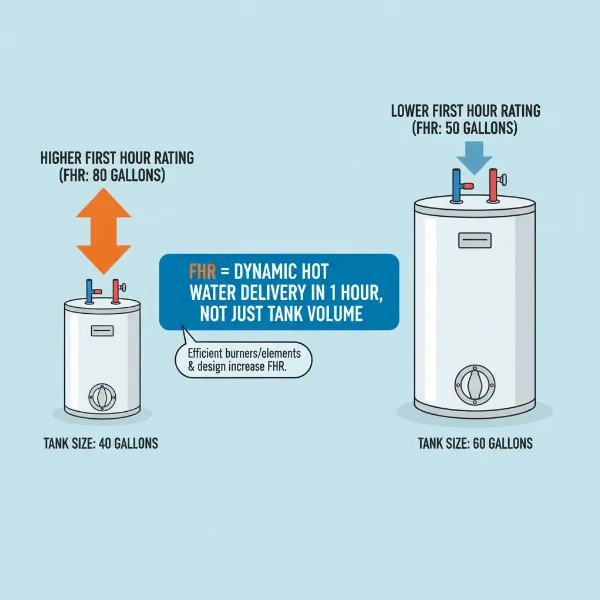 A diagram comparing two water heaters, illustrating how First Hour Rating differs from simple tank capacity.
How First Hour Rating is Calculated
The Department of Energy (DOE) establishes standardized test procedures to determine a water heater’s FHR, ensuring a consistent and reliable metric for comparison across brands. While the exact calculation is complex, a simplified formula provides a good understanding:
FHR = (Storage Volume × Percentage of Usable Hot Water) + (Recovery Rate × 60 minutes)
Here’s a breakdown of the components:
- Storage Volume: The nominal capacity of the tank in gallons.
- Percentage of Usable Hot Water: Typically around 70-75% of the tank’s total volume is considered truly hot and immediately usable before significant temperature drop occurs due to cold water mixing.
- Recovery Rate: This is the number of gallons of water the heater can warm to a usable temperature (e.g., a 90°F temperature rise) within one hour. It’s a measure of the heater’s ability to “recover” or replenish its hot water supply.
For example, a 50-gallon water heater with a recovery rate of 40 gallons per hour might have an FHR of 75 gallons: (50 gallons * 0.70) + 40 GPH = 35 + 40 = 75 gallons FHR. This illustrates how a tank initially holding 50 gallons can deliver more in an hour due to its efficient reheating capabilities.
Why Your First Hour Rating Matters More Than You Think
Understanding and prioritizing FHR when selecting a water heater is critical for several practical reasons:
- Avoiding Cold Showers: This is arguably the most immediate and frustrating consequence of an undersized water heater. If your heater’s actual hot water delivery (its FHR) cannot keep pace with your household’s peak demand, you’ll quickly run out of hot water, leaving someone with a lukewarm or completely cold shower. This is particularly crucial for homes with multiple occupants or those who enjoy longer showers.
- Supporting Simultaneous Use: Imagine multiple family members showering, the dishwasher running, and a load of laundry in the machine – all at the same time. A sufficient FHR ensures that all these activities can occur without a noticeable drop in hot water temperature or pressure. It’s about seamless hot water delivery for everyone, even during your busiest hours.
- Avoiding Oversizing and Undersizing: Focusing only on tank size can lead to inefficient choices. An undersized tank, regardless of its gallon capacity, will struggle to meet demand. Conversely, oversizing a tank beyond your actual FHR needs means you’re paying more upfront and potentially wasting energy to keep unused water hot, leading to higher utility bills. A high FHR allows you to potentially meet your needs with a physically smaller, more efficient unit.
- Optimizing Energy Efficiency: While FHR isn’t a direct measure of energy efficiency (Uniform Energy Factor, or UEF, is for that), choosing the correct FHR can indirectly impact your energy consumption. A heater perfectly matched to your peak demand won’t have to work overtime to catch up, leading to more efficient operation.
Determining Your Household’s FHR Needs
Choosing the right FHR requires a thoughtful assessment of your family’s hot water habits.
Assess Peak Hour Usage
Start by identifying the hour of the day when your household uses the most hot water. This “peak hour” is typically in the morning or evening. Consider all activities that require hot water:
- Showers: Approximately 10-15 gallons per 10-minute shower.
- Baths: 15-25 gallons per bath.
- Dishwasher: 6-10 gallons per cycle.
- Washing Machine (hot/warm cycle): 7-10 gallons per load.
- Hand Washing/Shaving: 1-2 gallons.
|
Our Picks for the Best Water Heater in 2026
As an Amazon Associate I earn from qualifying purchases.
|
||
| Num | Product | Action |
|---|---|---|
| 1 | Amazon Basics Electric Stainless Steel Kettle for Tea and Coffee, BPA-Free, Fast Boiling, Auto Shut-Off, 1.7 Liter, 1500W, Black and Silver |

|
| 2 | Cosori Electric Kettle, No Plastic Contact With Water, Wide Mouth For Easy Cleaning, Auto Shut Off, 1.7L Tea Kettle & Hot Water Boiler, Water Heater & Teapot, Borosilicate Glass, Black, 1500W |
|
| 3 | OVENTE Electric Kettle, 1.7L Fast Boiling Water Heater for Coffee or Tea, BPA Free with Water Level Gauge, Auto Shut-Off, Boil-Dry Protection, Indicator Light and Removable Filter, White KP72W |
|
| 4 | Portable Immersion Water Heater 1800W 120V, Electric Heater for Buckets, Bathtubs and Mini Pools, Submersible Design with Thermostat, Real Time Temperature Display and Dry Burn Protection |
|
| 5 | Amazon Basics Electric Kettle with Glass Carafe for Tea and Coffee, BPA-Free, Fast Boiling, Auto Shut-Off, 1.7 Liter, 1500W, Black and Silver |
|
| 6 | Zojirushi Micom Water Boiler and Warmer (135 oz. / 4L, Silver) |
|
| 7 | Chefman Electric Kettle, 1.8L 1500W, Hot Water Boiler, Removable Lid for Easy Cleaning, Auto Shut Off, Boil-Dry Protection, Stainless Steel Filter, BPA Free, Borosilicate Glass Electric Tea Kettle |
|
| 8 | Amazon Basics Electric Kettle with Glass Carafe for Tea and Coffee, BPA-Free, Fast Boiling, Auto Shut-Off, 1 Liter, 1500W, Glass and Steel |
|
| 9 | Portable Water Heater 2000W, Pool Heater - Immersion Heater with Digital Thermometer, Upgraded Magnesium Oxide Heating for Fast Heating, for Small Pools, Bathtubs, Buckets, Tanks |
|
| 10 | Immersion Water Heater Electric, 2000W Portable Water Heater with 304 S S Guard & LCD Thermometer, Fast Heating Bucket Heater, Ideal for Small Bucket Bathtub, Small Pool, Home Camping Outdoor Use |
|
Add up the estimated hot water usage for all simultaneous activities during your peak hour. This total will be your target FHR.
“Don’t just buy based on gallon size. If you see a high FHR and solid UEF, that’s the sweet spot for most families.” – Samantha Reyes, Home Comfort Contributor
FHR Recommendations by Household Size
While individual habits vary, these general guidelines can help:
- 1-2 People: A target FHR of 40-50 gallons is often sufficient.
- 3-4 People: Aim for an FHR between 50-70 gallons.
- 5-6 People: Look for an FHR of 70-90+ gallons to ensure ample hot water.
- Over 6 People or High Demand (e.g., large tubs, multiple simultaneous uses): An FHR of 90+ gallons or even considering multiple water heaters or tankless options might be necessary.
Where to Find the First Hour Rating
The FHR is readily available on the yellow EnergyGuide label attached to all new conventional storage water heaters. Look for “Capacity (first hour rating)” near the top-left corner. This label also provides other crucial information like the Uniform Energy Factor (UEF) and estimated yearly operating costs.
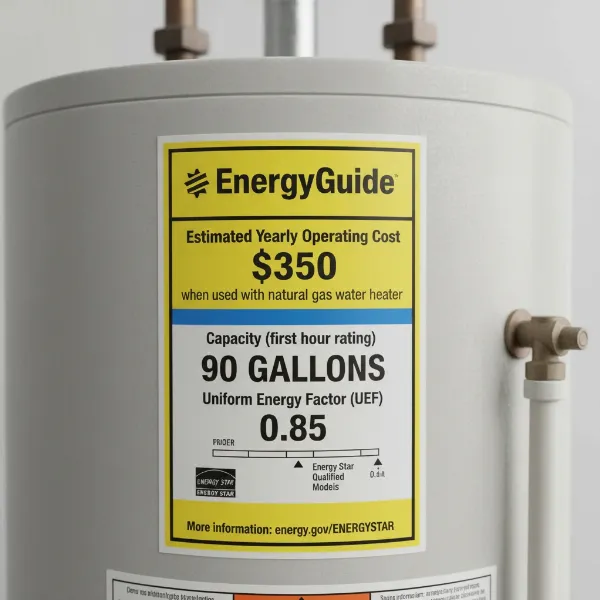 EnergyGuide label on a water heater, showing First Hour Rating and energy efficiency details.
Factors Influencing a Water Heater’s FHR
Several design and operational factors contribute to a water heater’s First Hour Rating:
- Fuel Type: Gas water heaters generally have higher recovery rates and thus higher FHRs than electric models of comparable tank size. This is because gas burners can heat water more quickly. Heat pump electric water heaters, while highly efficient, often have slower recovery times compared to traditional electric resistance models, making FHR particularly important for them.
- Element Wattage/Burner Size: For electric heaters, higher wattage elements mean faster reheating. For gas heaters, a larger BTU (British Thermal Unit) input burner provides quicker recovery.
- Insulation Quality: Good insulation reduces standby heat loss, meaning more of the stored hot water remains hot, effectively contributing to a higher FHR.
- Tank Lining and Design: The internal design and condition of the tank can affect how efficiently cold and hot water mix and how effectively heat is transferred.
- Thermostat Configuration: How the thermostat is set and how it cycles between heating elements can influence the sustained delivery of hot water.
- Ambient Temperature: The temperature of the surrounding environment where the water heater is located (e.g., a cold basement vs. a warmer utility closet) can affect recovery rates, especially for heat pump models.
Conclusion
When you’re in the market for a new water heater, or simply trying to understand your current one, remember that the physical tank size in gallons tells only part of the story. The First Hour Rating (FHR) is the real-world metric that truly defines a water heater’s ability to keep up with your family’s hot water demands during peak usage periods. By prioritizing FHR, assessing your household’s specific needs, and understanding the factors that influence this crucial rating, you can make an informed decision. Choosing a water heater with an appropriate FHR means saying goodbye to cold showers and hello to consistent comfort and convenience. So, next time you’re comparing models, ask not just “How many gallons?” but “What’s the First Hour Rating, and will it meet my family’s morning chaos?”
Frequently Asked Questions
What if my household’s peak hot water demand exceeds the water heater’s FHR?
If your household’s peak demand consistently exceeds your water heater’s FHR, you will likely experience lukewarm or cold water during busy periods. It indicates that your current heater struggles to meet your hot water needs. You might consider a water heater with a higher FHR, or exploring options like hybrid or tankless models for increased efficiency and on-demand hot water.
Can a smaller gallon tank have a higher FHR than a larger one?
Yes, absolutely. A smaller tank, especially a gas model or an electric one with a powerful element and excellent recovery rate, can have a higher FHR than a larger tank with slower recovery. This is why FHR is a more accurate measure of performance than tank size alone.
Is FHR applicable to tankless water heaters?
While tankless water heaters don’t have a “tank” in the traditional sense, their performance is measured by gallons per minute (GPM) rather than FHR. GPM indicates the continuous flow rate of hot water they can provide. However, the principle of matching output to demand remains the same.
How often should I reassess my FHR needs?
It’s a good idea to reassess your FHR needs if your household size changes significantly (e.g., new family members, children moving out), or if your hot water usage patterns evolve (e.g., adding a large spa tub, more frequent laundry). This ensures your Water Heater continues to provide optimal comfort.