Is your family constantly battling for hot water, or are you tired of paying high energy bills for a bulky tank water heater? The EcoSmart ECO 27 electric tankless water heater promises to solve these common household dilemmas by delivering endless hot water on demand with impressive energy efficiency. But in a market flooded with options, does this specific model truly live up to the hype, and is it the right investment for your home? Let’s dive into a comprehensive review of the EcoSmart ECO 27 to determine if its benefits outweigh its considerations, helping you make an informed decision for reliable and efficient hot water.
Understanding Electric Tankless Water Heaters: The EcoSmart ECO 27 Context
Electric tankless water heaters, often referred to as “on-demand” or “direct” water heaters, represent a significant departure from traditional tank-style systems. Unlike their conventional counterparts, which store and continuously heat a large volume of water, tankless units only activate when hot water is needed. Water flows through a heating element, is rapidly warmed to the desired temperature, and then delivered to your faucet or shower. This innovative approach eliminates standby heat loss, a major energy drain for tank heaters, and provides an uninterrupted supply of hot water.
The EcoSmart ECO 27 is a prime example of a whole-home electric tankless water heater. Its compact design allows for installation in tight spaces, freeing up valuable utility room or closet real estate. Beyond its physical footprint, the ECO 27 is engineered with advanced self-modulating technology, a cornerstone of its energy-saving capabilities. This system intelligently adjusts power consumption based on the amount of hot water being used and the incoming water temperature, ensuring that only the necessary energy is expended. This smart technology, combined with its high efficiency, makes the ECO 27 an appealing alternative for homeowners seeking to reduce their environmental impact and utility costs.
EcoSmart ECO 27 Features and Performance Breakdown
The EcoSmart ECO 27 is designed to be a robust solution for households with significant hot water demands. Understanding its core features and how they translate into real-world performance is crucial for any potential buyer.
Key Specifications
|
Our Picks for the Best Water Heater in 2026
As an Amazon Associate I earn from qualifying purchases.
|
||
| Num | Product | Action |
|---|---|---|
| 1 | Portable Immersion Water Heater 1800W 120V, Electric Heater for Buckets, Bathtubs and Mini Pools, Submersible Design with Thermostat, Real Time Temperature Display and Dry Burn Protection |

|
| 2 | Amazon Basics Electric Stainless Steel Kettle for Tea and Coffee, BPA-Free, Fast Boiling, Auto Shut-Off, 1.7 Liter, 1500W, Black and Silver |
|
| 3 | Zojirushi Micom Water Boiler and Warmer (135 oz. / 4L, Silver) |
|
| 4 | Amazon Basics Electric Kettle with Glass Carafe for Tea and Coffee, BPA-Free, Fast Boiling, Auto Shut-Off, 1.7 Liter, 1500W, Black and Silver |
|
| 5 | OVENTE Electric Kettle, 1.7L Fast Boiling Water Heater for Coffee or Tea, BPA Free with Water Level Gauge, Auto Shut-Off, Boil-Dry Protection, Indicator Light and Removable Filter, White KP72W |
|
| 6 | Chefman Electric Kettle, 1.8L 1500W, Hot Water Boiler, Removable Lid for Easy Cleaning, Auto Shut Off, Boil-Dry Protection, Stainless Steel Filter, BPA Free, Borosilicate Glass Electric Tea Kettle |
|
| 7 | Amazon Basics Electric Kettle with Glass Carafe for Tea and Coffee, BPA-Free, Fast Boiling, Auto Shut-Off, 1 Liter, 1500W, Glass and Steel |
|
| 8 | Immersion Water Heater Electric, 2000W Portable Water Heater with 304 S S Guard & LCD Thermometer, Fast Heating Bucket Heater, Ideal for Small Bucket Bathtub, Small Pool, Home Camping Outdoor Use |
|
| 9 | Cosori Electric Kettle, No Plastic Contact With Water, Wide Mouth For Easy Cleaning, Auto Shut Off, 1.7L Tea Kettle & Hot Water Boiler, Water Heater & Teapot, Borosilicate Glass, Black, 1500W |
|
| 10 | Portable Water Heater 2000W, Pool Heater - Immersion Heater with Digital Thermometer, Upgraded Magnesium Oxide Heating for Fast Heating, for Small Pools, Bathtubs, Buckets, Tanks |
|
This model boasts 27 kilowatts (kW) of heating power, operating at 240 volts (V). Its amperage draw is approximately 112.5-113 amps. The unit itself is remarkably compact, typically measuring around 17 x 17 x 3.625 inches and weighing about 14.7 pounds, making it significantly smaller than traditional tank heaters.
Self-Modulating Technology
At the heart of the ECO 27’s efficiency is its patented self-modulating technology. This intelligent system doesn’t simply turn on and off; it continuously monitors the incoming water temperature and the desired output temperature. Based on this data, it precisely adjusts the power to the heating elements. For instance, if the incoming water is warmer or the hot water demand is low, the unit will consume less energy. This dynamic adaptation ensures consistent hot water delivery while optimizing energy usage, preventing energy waste common in fixed-output systems.
Digital Temperature Control
User control is paramount, and the EcoSmart ECO 27 delivers with a digital temperature display and controls that allow for precise adjustments in 1-degree Fahrenheit increments. Users can set the desired hot water temperature anywhere between 80°F and 140°F (26°C – 60°C). This granular control not only enhances comfort but also helps in fine-tuning energy consumption.
Hot Water Output (GPM)
The ECO 27’s hot water output is measured in Gallons Per Minute (GPM), and this rate is directly influenced by the incoming water temperature. In warmer climates where groundwater temperatures are higher (e.g., 70°F), the unit can produce an impressive 5.3 to 6.5 GPM, ample for running multiple showers and appliances simultaneously. However, in colder northern climates, where incoming water temperatures can drop as low as 37°F, the output naturally decreases to around 3 GPM. This flow rate is generally sufficient for one or two showers running concurrently, especially with low-flow showerheads, but might struggle to maintain super-hot temperatures across three or more high-demand fixtures simultaneously.
Durability and Components
EcoSmart emphasizes durability by utilizing copper and stainless steel components in the ECO 27’s construction. The copper heat exchanger is designed for efficient heat transfer and corrosion resistance, contributing to the unit’s longevity. Furthermore, its heating elements are replaceable, simplifying maintenance. The unit also comes with a limited lifetime warranty covering electronics, heat exchangers, and heating elements, providing peace of mind for long-term ownership, provided installation guidelines are met.
EcoSmart ECO 27 at a Glance: Pros and Cons
Choosing a water heater is a significant decision. Here’s a balanced look at the advantages and potential drawbacks of the EcoSmart ECO 27 to help weigh your options.
| Feature | Pros | Cons |
|---|---|---|
| Hot Water Supply | Provides an endless, on-demand supply of hot water, eliminating cold showers. | A slight delay can occur before hot water reaches distant faucets, typical for tankless units. |
| Energy Efficiency | Up to 99.8% energy efficient, potentially cutting water heating costs by up to 50% compared to tank models. | Requires substantial electrical infrastructure (high amperage draw), which may necessitate costly panel upgrades. |
| Size & Space | Incredibly compact, saving up to 93% more space than traditional tank heaters. | N/A |
| Temperature Control | Precise digital control allows 1-degree Fahrenheit adjustments for personalized comfort. | Hot water output (GPM) can decrease significantly in colder climates or when multiple fixtures run simultaneously, affecting consistency. |
| Warranty | Offers a limited lifetime warranty on key components (elements, exchanger, electronics). | The lifetime warranty typically requires professional installation to be valid. |
| Installation | No venting required, simplifying placement options. | Professional installation is strongly recommended due to complex electrical and plumbing requirements. |
Is the EcoSmart ECO 27 Right for Your Home? A Buying Guide Perspective
Deciding if the EcoSmart ECO 27 is the right fit involves a careful assessment of your household’s specific needs, your climate, and your home’s existing infrastructure. It’s not a one-size-fits-all solution, but for many, it can be a transformative upgrade.
Assessing Your Hot Water Needs
Consider the size of your family and your peak hot water demand. For households with 2-4 people and moderate use, the ECO 27 typically performs exceptionally well. If you frequently run multiple high-flow showers, a dishwasher, and a washing machine simultaneously, especially in colder climates, you might experience a slight dip in output temperature or flow rate. For very large families with constant, concurrent hot water needs, careful planning, or even a second point-of-use tankless unit, might be necessary.
Climate Considerations
The performance of any electric tankless water heater, including the ECO 27, is directly tied to the incoming groundwater temperature. In warm Southern regions where water enters the home at 60°F or higher, the ECO 27 can easily support multiple hot water demands. However, in colder Northern states where incoming water can drop to 40°F or less, the unit’s ability to heat a large volume of water to high temperatures simultaneously will be reduced. While still capable of providing hot water, users in these areas may need to manage expectations for concurrent use, perhaps by installing low-flow fixtures.
Evaluating Your Electrical System
This is often the most critical factor for the EcoSmart ECO 27. The unit requires substantial electrical capacity: a 240V service with a maximum draw of 112.5-113 amps, necessitating three dedicated 40 amp double-pole breakers and three sets of 8 AWG wire. It’s also recommended to have a 200 amp household electrical service panel. Many older homes, or even some newer ones, may not have this capacity available without a costly electrical panel upgrade. A licensed electrician must assess your current system to ensure it can safely support the ECO 27, or to quote the necessary upgrades.
Budgeting for Installation
While the unit itself can be competitively priced, the installation cost for the EcoSmart ECO 27 can be a significant factor. Due to the precise electrical requirements and plumbing connections (using 3/4″ NPT fittings), professional installation by a licensed electrician and plumber is highly recommended. Not only does this ensure safety and compliance with local codes, but it is also a prerequisite for validating the limited lifetime warranty. Factor in these professional labor costs, which can sometimes rival the cost of the unit itself, when considering your total budget.
Maximizing Your EcoSmart ECO 27: Tips for Use and Maintenance
To ensure your EcoSmart ECO 27 operates efficiently and reliably for years to come, proactive use and maintenance are key.
Optimal Temperature Setting
While the ECO 27 offers a wide temperature range, setting the thermostat to the lowest comfortable temperature (typically between 105°F and 120°F for most household uses) can significantly reduce energy consumption. Avoid setting it unnecessarily high, as this increases electricity usage and poses a scalding risk. Experiment to find the perfect balance for your family’s needs.
Regular Cleaning and Flushing
Over time, mineral deposits from hard water can accumulate within the heating elements and heat exchanger, reducing efficiency and potentially leading to damage. Regular flushing of your tankless water heater, typically once a year, is crucial. This process usually involves isolating the unit, connecting a descaling kit, and circulating a vinegar solution or commercial descaler to dissolve mineral buildup. While professional help is available, many homeowners can perform this task with basic tools and careful adherence to the manufacturer’s instructions.
Electrical Safety Checks
Given the high electrical demands of the ECO 27, periodic visual inspection of the wiring, breakers, and connections is a wise practice. Ensure there are no signs of overheating, loose connections, or corrosion. If you notice anything unusual, such as flickering lights or burning smells, immediately consult a licensed electrician. Proper grounding and robust electrical connections are paramount for safe operation.
Understanding Flow Rates
Manage your hot water expectations, especially during peak usage. If you live in a colder climate, or if you have a larger family, be mindful that running multiple high-flow fixtures simultaneously might lead to a slight drop in water temperature. Installing low-flow showerheads and aerators can help mitigate this by reducing the overall GPM demand on the unit, allowing it to maintain hotter temperatures more effectively.
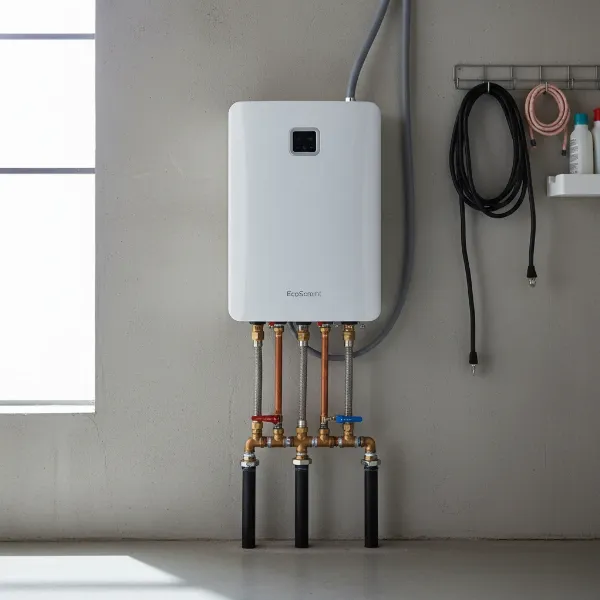 EcoSmart ECO 27 tankless water heater installed in a small utility space, highlighting its compact design and efficient use of space.
Conclusion
The EcoSmart ECO 27 electric tankless water heater stands out as a powerful and efficient solution for providing on-demand hot water, especially for those seeking to minimize energy consumption and reclaim valuable space. Its self-modulating technology, precise digital temperature control, and robust construction offer compelling advantages. While the promise of endless hot water and significant energy savings is very attractive, the critical electrical requirements mean it’s not a universal fit without prior assessment.
For homeowners with adequate electrical service or those prepared for potential electrical upgrades, the ECO 27 can be a truly worthwhile investment, offering long-term savings and unparalleled convenience. It’s an excellent choice for moderate to large families in warm to temperate climates, and still a viable option for colder regions with mindful usage and appropriate fixtures. Ultimately, the EcoSmart ECO 27 is a high-performance unit that delivers on its promises for the right household, making it a strong contender in the electric tankless market.
What has been your experience with tankless Water Heaters, and what features are most important to you in a hot water system?
Frequently Asked Questions
What is the maximum number of showers the EcoSmart ECO 27 can support simultaneously?
In warmer climates with higher incoming water temperatures (e.g., 70°F), the EcoSmart ECO 27 can comfortably support 3-4 showers simultaneously, delivering up to 6.5 GPM. In colder climates with lower incoming water temperatures (e.g., 40°F), it’s more realistically suited for 1-2 showers, providing around 3 GPM, especially if low-flow showerheads are used.
What are the exact electrical requirements for installing the EcoSmart ECO 27?
The EcoSmart ECO 27 requires a 240V electric service, with a maximum draw of 112.5-113 amps. It needs three dedicated 40 amp double-pole circuit breakers and three sets of 8 AWG (American Wire Gauge) wire. A 200 amp household electrical service panel is generally recommended to support these demands.
Can I install the EcoSmart ECO 27 myself, or do I need a professional?
While some DIY-savvy individuals might attempt it, professional installation by a licensed electrician and plumber is highly recommended. This ensures safety, compliance with local electrical and plumbing codes, and is often a mandatory requirement to qualify for the unit’s limited lifetime warranty.
How much energy can I realistically save with the EcoSmart ECO 27?
The EcoSmart ECO 27 boasts up to 99.8% energy efficiency, and many users report savings of 20-50% on their water heating portion of the utility bill. Actual savings depend heavily on your household’s hot water usage patterns, local electricity rates, and the incoming water temperature in your area.
Is the EcoSmart ECO 27 a good choice for homes in extremely cold northern states?
Yes, the EcoSmart ECO 27 is configured to operate in cold climates, capable of heating water even with incoming temperatures as low as 37°F. However, its GPM output will be lower (around 3 GPM) compared to warmer regions. For optimal performance in very cold areas, consider installing low-flow fixtures and managing simultaneous hot water usage.