The quest for more efficient, eco-friendly home heating solutions is constantly driving innovation in the water heater industry. While traditional gas and electric models remain common, and heat pump technology gains traction, a revolutionary concept is stirring excitement: microwave water heaters. Could the same technology that quickly heats your leftovers soon provide endless hot water for your entire home? This idea, once seemingly far-fetched, is steadily progressing from theoretical designs to working prototypes, promising a future of heating that is both compact and potentially more sustainable.
What Exactly Is a Microwave Water Heater?
At its core, a microwave water heater, often referred to as a microwave boiler, utilizes electromagnetic waves, specifically microwaves, to directly heat water. Unlike conventional water heaters that rely on heating elements or flames to transfer heat through a medium, microwave systems excite water molecules themselves, causing them to vibrate rapidly and generate heat. This direct energy transfer is the fundamental difference, offering the potential for instantaneous hot water delivery without the need for a bulky storage tank or the combustion of fossil fuels. Imagine turning on the tap and having hot water almost immediately, heated precisely when and where you need it.
The Promises: Advantages of Microwave Water Heating
The potential benefits of microwave water heating are quite compelling, aligning with modern demands for efficiency and environmental responsibility. One of the most frequently cited advantages is high energy efficiency. Some developers, such as the British company BoilerWave, claim their microwave boilers achieve efficiency rates as high as 96%. This efficiency purportedly surpasses many traditional heating systems by converting electricity directly into heat within the water, and often incorporates mechanisms to recapture waste heat from the magnetrons.
Another significant advantage is the elimination of direct emissions. Since microwave heating doesn’t involve combustion, it produces no carbon dioxide or nitrogen oxides at the point of use, making it a cleaner option for residential heating and contributing to reduced carbon footprints. This aligns perfectly with global efforts to transition away from fossil fuels.
Furthermore, microwave heating systems can be remarkably compact. Designs suggest units could be significantly smaller than conventional thermal storage cylinders, freeing up valuable space in homes. Their ability to heat water on demand also means the potential to move away from large, energy-intensive storage tanks, offering greater installation flexibility and potentially lower standby energy losses.
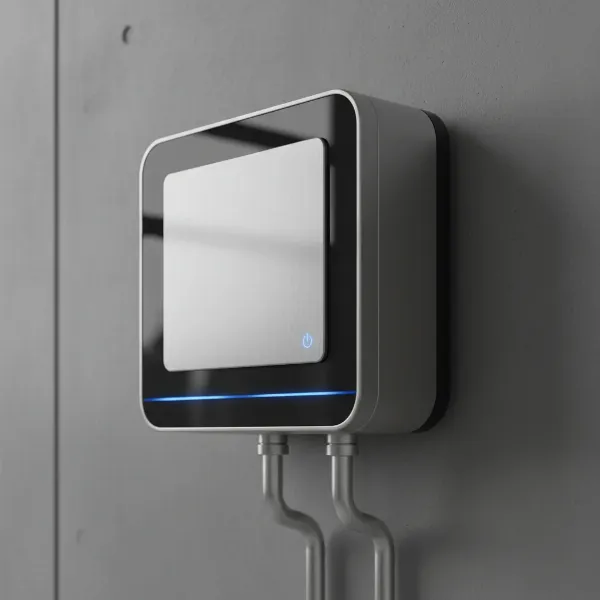 A futuristic, compact microwave water heater unit mounted on a wall with glowing blue water pipes.
The Reality Check: Challenges and Disadvantages
While the promise of microwave water heaters is exciting, the technology still faces several significant hurdles before widespread residential adoption.
One major consideration is cost. The magnetron units required to generate enough microwave power for whole-house hot water would need to be substantially larger and more powerful than those found in kitchen microwaves, leading to higher manufacturing costs compared to inexpensive resistive heating elements. The complexity of the electronics and safety systems also adds to the expense.
The efficiency debate is another critical point. While developers tout high efficiency, many engineers highlight that electric resistance water heaters are already nearly 100% efficient at converting electrical energy directly into heat within the water. Standard household microwaves, on the other hand, convert electricity to microwaves with efficiencies often ranging from 47% to 67%, with the remaining energy lost as heat from the magnetron and other components. For a microwave water heater to be truly more efficient than simple resistive heating, it would need to effectively capture and utilize this “waste” heat, adding complexity to the design. In many regions, highly efficient heat pump water heaters, which can achieve a Coefficient of Performance (COP) of 300-400% by moving heat rather than generating it, are already considered a more efficient “future” technology.
Another technical challenge is uneven heating. Microwaves can sometimes heat water inconsistently, potentially leading to “superheated” pockets or layers of boiling water at the top while the lower portions remain cooler. Researchers are actively working on solutions, such as specially designed cavities and waveguides, to ensure more uniform heat distribution within the water flow.
Finally, the power demands for heating large volumes of water instantaneously can be substantial. Just like tankless electric resistance water heaters, microwave systems would require significant electrical input, potentially necessitating expensive electrical service upgrades for many homes. The scalability for rapidly heating the many gallons needed for a shower or multiple appliances simultaneously also presents an engineering challenge with current microwave technology.
Microwave Water Heaters vs. Traditional Options
To better understand where microwave technology fits, let’s compare it with existing water heating solutions:
| Feature | Direct Electric (Tankless) | Storage Electric | Gas (Tank/Tankless) | Heat Pump Water Heater | Microwave Water Heater (Potential) |
|---|---|---|---|---|---|
| Efficiency (Operational) | ~98-99% | ~90-95% | ~60-80% | ~300-400% | ~90-96% (claimed) |
| Initial Cost | Medium-High | Low-Medium | Medium | High | High (estimated) |
| Environmental Impact | Zero direct emissions | Zero direct emissions | Carbon emissions | Zero direct emissions | Zero direct emissions |
| Size | Compact | Large | Medium-Large | Large | Very Compact |
| On-Demand Hot Water | Yes | No (storage) | Yes (tankless) / No (storage) | No (storage) | Yes |
| Energy Source | Electricity | Electricity | Natural Gas/Propane | Electricity (moves heat) | Electricity |
| Installation Complexity | Medium-High | Low | Medium | High | High (estimated) |
Is the Future Here Yet? Current Status and Market Outlook
While “microwave water heaters” might still sound like something from a science fiction novel, the underlying technology is certainly real and under development. Companies like BoilerWave are actively promoting microwave boiler products for residential heating, and numerous patents and research initiatives highlight ongoing efforts.
However, widespread commercial availability and mass adoption for residential whole-house hot water heating are not yet a reality. The systems currently available are often positioned as replacements for traditional gas boilers in specific markets, rather than a direct competitor to electric resistance or the increasingly popular heat pump water heaters. The challenges of cost, power requirements, and ensuring consistent heating for large volumes of water at a residential scale are still being addressed.
Many industry experts view heat pump water heaters as the most efficient and environmentally friendly “future of heating” technology currently available and widely adopted, offering proven performance and significant energy savings. Microwave technology, while promising for its direct heating capabilities and compact size, needs to overcome its practical limitations and establish a clear advantage in terms of overall lifecycle cost and efficiency for the average homeowner to truly become mainstream. The innovation continues, and while they might not be in every home just yet, microwave water heaters represent an exciting direction in our ongoing search for better heating solutions.
“Innovation in water heating is crucial for a sustainable future, and microwave technology offers intriguing possibilities, particularly in its potential for compact, on-demand, and emission-free heating. However, real-world efficiency and cost-effectiveness for residential applications remain key areas for further development.”
Conclusion
The prospect of microwave water heaters heralds an exciting chapter in home heating, promising a future where hot water is delivered efficiently, on demand, and without direct carbon emissions. While developers have showcased impressive prototypes and touted high efficiency, the journey from innovation to mainstream adoption for the average household is still unfolding. Challenges such as initial cost, grid compatibility, and ensuring uniform heating for large volumes need to be met with robust engineering solutions. As technology evolves, staying informed about these advancements will be crucial for homeowners looking to upgrade their systems. Will microwave water heaters become the standard for the next generation, or will other technologies lead the way? Only time, and continued innovation, will tell.
Frequently Asked Questions
Are microwave water heaters safe for home use?
|
Our Picks for the Best Water Heater in 2026
As an Amazon Associate I earn from qualifying purchases.
|
||
| Num | Product | Action |
|---|---|---|
| 1 | Cosori Electric Kettle, No Plastic Contact With Water, Wide Mouth For Easy Cleaning, Auto Shut Off, 1.7L Tea Kettle & Hot Water Boiler, Water Heater & Teapot, Borosilicate Glass, Black, 1500W |

|
| 2 | Amazon Basics Electric Stainless Steel Kettle for Tea and Coffee, BPA-Free, Fast Boiling, Auto Shut-Off, 1.7 Liter, 1500W, Black and Silver |
|
| 3 | OVENTE Electric Kettle, 1.7L Fast Boiling Water Heater for Coffee or Tea, BPA Free with Water Level Gauge, Auto Shut-Off, Boil-Dry Protection, Indicator Light and Removable Filter, White KP72W |
|
| 4 | Amazon Basics Electric Kettle with Glass Carafe for Tea and Coffee, BPA-Free, Fast Boiling, Auto Shut-Off, 1.7 Liter, 1500W, Black and Silver |
|
| 5 | Immersion Water Heater Electric, 2000W Portable Water Heater with 304 S S Guard & LCD Thermometer, Fast Heating Bucket Heater, Ideal for Small Bucket Bathtub, Small Pool, Home Camping Outdoor Use |
|
| 6 | Portable Water Heater 2000W, Pool Heater - Immersion Heater with Digital Thermometer, Upgraded Magnesium Oxide Heating for Fast Heating, for Small Pools, Bathtubs, Buckets, Tanks |
|
| 7 | Chefman Electric Kettle, 1.8L 1500W, Hot Water Boiler, Removable Lid for Easy Cleaning, Auto Shut Off, Boil-Dry Protection, Stainless Steel Filter, BPA Free, Borosilicate Glass Electric Tea Kettle |
|
| 8 | Amazon Basics Electric Kettle with Glass Carafe for Tea and Coffee, BPA-Free, Fast Boiling, Auto Shut-Off, 1 Liter, 1500W, Glass and Steel |
|
| 9 | Zojirushi Micom Water Boiler and Warmer (135 oz. / 4L, Silver) |
|
| 10 | Portable Immersion Water Heater 1800W 120V, Electric Heater for Buckets, Bathtubs and Mini Pools, Submersible Design with Thermostat, Real Time Temperature Display and Dry Burn Protection |
|
Yes, properly designed microwave water heaters are intended to be safe. Like microwave ovens, they would incorporate shielding and safety mechanisms to contain radiation. Manufacturers prioritize safety, but as with any new technology, adherence to strict standards is essential.
How efficient are microwave water heaters compared to electric resistance heaters?
While some microwave Water Heater developers claim high efficiencies (e.g., 96%), standard electric resistance heaters are nearly 100% efficient at converting electricity directly into heat in the water. The overall efficiency of microwave systems depends heavily on how effectively they manage magnetron losses and achieve uniform heating.
Can I replace my gas boiler with a microwave boiler today?
While some microwave boiler products are emerging, widespread replacement of conventional gas boilers with microwave units is not yet common. Availability varies by region, and factors like installation cost, electrical infrastructure requirements, and product maturity still limit their broad market penetration compared to established alternatives or heat pump systems.
What are the main components of a microwave water heater?
The core components typically include a magnetron (to generate microwaves), a waveguide or cavity (to direct and contain the microwaves), and a system to circulate water through the microwave field. Advanced designs may also incorporate heat exchangers to recover waste heat from the magnetron for improved overall efficiency.