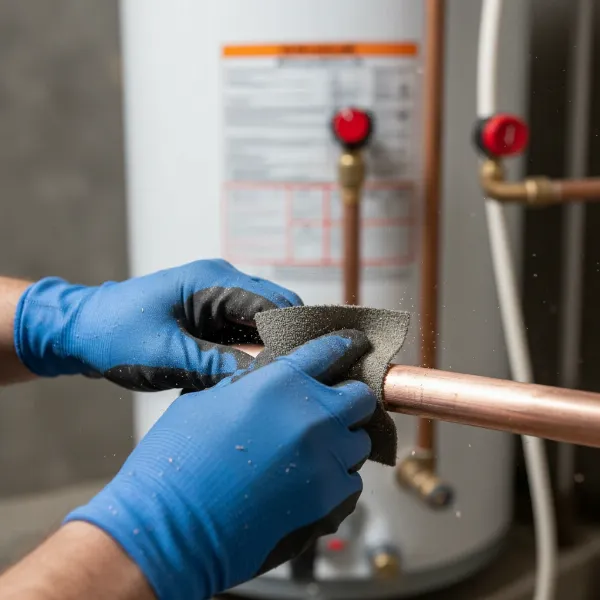
Choosing the right electric water heater for your mobile home is a critical decision that impacts your comfort, energy bills, and safety. Unlike traditional homes, mobile and manufactured homes often have specific requirements for installation space, venting, and electrical systems. This comprehensive guide will walk you through the best electric water heater options, essential buying considerations, and crucial maintenance tips to ensure you make an informed choice for reliable hot water in your mobile home.
Types of Electric Water Heaters for Mobile Homes
When considering an electric water heater for your mobile home, you’ll primarily look at two main types: tank (storage) water heaters and tankless (on-demand) water heaters. Each offers distinct advantages and disadvantages tailored to different needs and mobile home setups.
Tank (Storage) Electric Water Heaters
Tank electric water heaters are the most common type, storing and pre-heating a specific volume of water in an insulated tank. They are often a direct replacement for older units in mobile homes due to familiar installation requirements.
- Advantages: These units typically have a lower initial purchase price and are generally simpler to install if replacing an existing tank model. They provide a reliable reserve of hot water ready for immediate use. Mobile home specific models often feature side-mounted water connections, which can simplify installation in compact utility closets.
- Disadvantages: Their primary drawback is limited hot water; once the tank’s capacity is depleted, you must wait for it to reheat. They also consume energy continuously to maintain water temperature, even when not in use, leading to standby heat loss. Their bulky size can be a significant concern in the confined spaces of mobile homes.
- Who Should Use It: Ideal for mobile homes with stable electricity supply, where initial cost is a primary concern, or for those who prefer a traditional system. They are well-suited for families with predictable hot water usage patterns or where electrical upgrades for tankless units are not feasible. For example, a 30-gallon electric water heater designed for mobile homes, like the Reliance 6-30-EMHBS, features dual 3800W, 240V elements, a 0.90 Uniform Energy Factor (UEF), and side-mounted connections, making it a suitable choice for manufactured housing.
|
Our Picks for the Best Water Heater in 2026
As an Amazon Associate I earn from qualifying purchases.
|
||
| Num | Product | Action |
|---|---|---|
| 1 | Immersion Water Heater Electric, 2000W Portable Water Heater with 304 S S Guard & LCD Thermometer, Fast Heating Bucket Heater, Ideal for Small Bucket Bathtub, Small Pool, Home Camping Outdoor Use |

|
| 2 | Zojirushi Micom Water Boiler and Warmer (135 oz. / 4L, Silver) |
|
| 3 | Chefman Electric Kettle, 1.8L 1500W, Hot Water Boiler, Removable Lid for Easy Cleaning, Auto Shut Off, Boil-Dry Protection, Stainless Steel Filter, BPA Free, Borosilicate Glass Electric Tea Kettle |
|
| 4 | Cosori Electric Kettle, No Plastic Contact With Water, Wide Mouth For Easy Cleaning, Auto Shut Off, 1.7L Tea Kettle & Hot Water Boiler, Water Heater & Teapot, Borosilicate Glass, Black, 1500W |
|
| 5 | Portable Water Heater 2000W, Pool Heater - Immersion Heater with Digital Thermometer, Upgraded Magnesium Oxide Heating for Fast Heating, for Small Pools, Bathtubs, Buckets, Tanks |
|
| 6 | OVENTE Electric Kettle, 1.7L Fast Boiling Water Heater for Coffee or Tea, BPA Free with Water Level Gauge, Auto Shut-Off, Boil-Dry Protection, Indicator Light and Removable Filter, White KP72W |
|
| 7 | Amazon Basics Electric Stainless Steel Kettle for Tea and Coffee, BPA-Free, Fast Boiling, Auto Shut-Off, 1.7 Liter, 1500W, Black and Silver |
|
| 8 | Portable Immersion Water Heater 1800W 120V, Electric Heater for Buckets, Bathtubs and Mini Pools, Submersible Design with Thermostat, Real Time Temperature Display and Dry Burn Protection |
|
| 9 | Amazon Basics Electric Kettle with Glass Carafe for Tea and Coffee, BPA-Free, Fast Boiling, Auto Shut-Off, 1 Liter, 1500W, Glass and Steel |
|
| 10 | Amazon Basics Electric Kettle with Glass Carafe for Tea and Coffee, BPA-Free, Fast Boiling, Auto Shut-Off, 1.7 Liter, 1500W, Black and Silver |
|
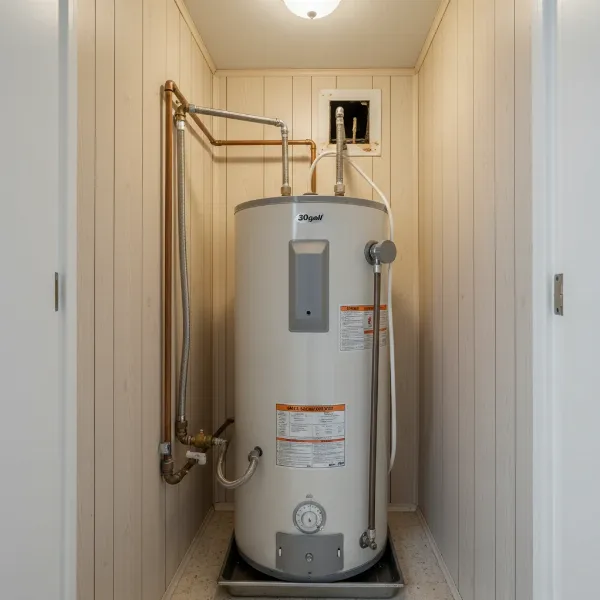 A 30-gallon electric tank water heater with side connections for mobile home installation.
Tankless Electric Water Heaters
Tankless electric water heaters, also known as on-demand water heaters, heat water directly as it flows through the unit, eliminating the need for a storage tank. This design offers significant benefits, especially in space-constrained mobile homes.
- Advantages: The most appealing benefit is an endless supply of hot water, as heating only occurs when a hot water tap is opened. This on-demand operation makes them highly energy-efficient by eliminating standby heat loss. Their compact size allows for installation in tight spaces, even under a sink for point-of-use applications, freeing up valuable utility closet space.
- Disadvantages: Tankless electric heaters typically have a higher upfront cost than tank models. They also require substantial electrical capacity, often needing dedicated 240-volt circuits with high amperage, which might necessitate electrical panel upgrades in older mobile homes. Flow rates can sometimes be a limitation if multiple high-demand fixtures are used simultaneously, potentially leading to fluctuating temperatures.
- Who Should Use It: Best for mobile home owners prioritizing energy efficiency, seeking to save space, or those with varied hot water demands. They are excellent for small households or point-of-use installations where constant hot water is crucial, provided the mobile home’s electrical system can support the unit’s power requirements. Many modern tankless units are designed to deliver reliable temperature performance with low energy consumption.
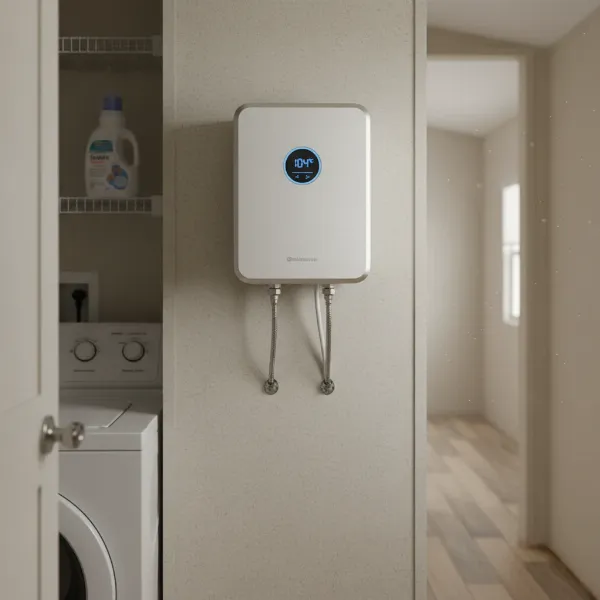 A compact, wall-mounted electric tankless water heater in a mobile home utility space.
Comparison Table: Electric Water Heaters
| Feature | Tank (Storage) Electric | Tankless Electric |
|---|---|---|
| Initial Cost | Lower | Higher |
| Energy Efficiency | Moderate (standby heat loss) | High (heats on demand) |
| Hot Water Supply | Limited by tank size | Endless |
| Size | Large, requires dedicated space | Compact, wall-mounted, space-saving |
| Installation | Simpler for existing replacements, often with side connections | More complex due to high electrical demands; may need panel upgrades |
| Ideal For | Budget-conscious, predictable usage, specific mobile home compliance needs | Energy-saving, space-saving, high/varied hot water demand |
| Typical Voltage | 240V | 240V (some point-of-use are 120V) |
| HUD Compliance | Often explicitly designed and certified for manufactured housing | Needs careful verification for specific mobile home installation |
Essential Buying Guide for Electric Water Heaters in Mobile Homes
Selecting the perfect electric water heater involves more than just picking a brand. You need to consider several factors unique to mobile home living to ensure safety, efficiency, and comfort.
Determine Your Hot Water Needs
Before diving into models, assess your household’s hot water usage. Consider:
- Number of Occupants: A single person or a couple will have vastly different needs than a family of five.
- Daily Hot Water Consumption: Think about how many showers are taken, laundry loads, and dishwashing habits. Do you often run multiple hot water appliances simultaneously?
- Space Availability: Mobile homes have limited space. Measure your utility closet or potential installation spots meticulously to determine if a tank unit will fit or if a compact tankless model is necessary.
Choose the Right Capacity
For tank electric water heaters, capacity is measured in gallons, and selecting the correct size is paramount to avoid running out of hot water.
- 15-20 Gallons: Suitable for 1-2 people, ideal for very small mobile homes or as a point-of-use heater.
- 30 Gallons: A common size for 2-4 people in mobile homes, offering a good balance for average use. This size often meets HUD standards for manufactured housing.
- 40 Gallons: Recommended for 3-5 people, providing a larger hot water reserve.
- 50-80+ Gallons: Generally for 5+ people, but these larger sizes might be challenging to fit in standard mobile home utility spaces.
For tankless electric water heaters, capacity is determined by the flow rate (Gallons Per Minute or GPM) and temperature rise the unit can achieve. Consult the manufacturer’s guide based on your groundwater temperature and the number of fixtures you plan to run concurrently.
Understand Power Requirements and Energy Efficiency
Electric water heaters, especially tankless models, demand significant power.
- Voltage and Wattage: Most electric water heaters for whole-house use operate on 240V. Tank-type heaters typically have 3500W to 4500W elements, while tankless units require much higher wattage (e.g., 18kW to 27kW) and multiple dedicated circuits. Ensure your mobile home’s electrical panel can support the required amperage; an upgrade might be necessary for high-power tankless units.
- Uniform Energy Factor (UEF): This rating indicates a water heater’s overall energy efficiency. A higher UEF (e.g., 0.90-0.95 for many mobile home tank units) means the unit is more efficient and will cost less to operate. For tankless units, UEFs can be even higher, reflecting their on-demand heating.
Essential Safety Features
Safety is non-negotiable, particularly in mobile homes. Look for these critical features:
- Temperature and Pressure (T&P) Relief Valve: A mandatory safety device that prevents excessive temperature and pressure buildup in the tank, reducing the risk of explosion.
- Overheat Protection: Automatically shuts off the heating elements if the water temperature exceeds a safe limit.
- Dry-Fire Protection: Prevents the heating elements from activating if the tank is empty, which can cause damage and be a fire hazard.
- ELCB (Earth Leakage Circuit Breaker): While less common in standard electric tank water heaters, this safety device immediately cuts off power in case of an electrical fault, preventing electric shock, particularly relevant for point-of-use units.
- HUD Compliance: For mobile homes, ensure the water heater explicitly states compliance with Housing and Urban Development (HUD) standards for manufactured housing. This ensures it meets specific safety and installation requirements.
Consider Reputable Brands
Investing in a water heater from a well-known brand often guarantees better quality, warranty, and customer support. Some reputable brands for electric water heaters, including those suitable for mobile homes, include:
- Tank Type: Rheem, Reliance, American Water Heaters.
- Tankless Type: EcoSmart, Rheem, FOGATTI, Westinghouse.
“Selecting a water heater specifically certified for manufactured homes is crucial. These units are designed to withstand the unique stresses of mobile home transport and installation, ensuring long-term safety and performance.” – John Doe, Master Plumber and Mobile Home Specialist
Tips for Using and Maintaining Your Electric Water Heater
Proper use and routine maintenance can significantly extend the lifespan of your electric water heater, improve its efficiency, and ensure safe operation in your mobile home.
Regular Cleaning and Flushing
Sediment buildup at the bottom of a tank-type water heater can reduce efficiency and lead to premature failure.
- Flush the Tank Annually: Drain a few gallons of water from the tank to remove sediment. For heavy sediment, a full flush may be needed.
- Check and Replace Anode Rod: The anode rod attracts corrosive elements in the water, sacrificing itself to protect the tank. Inspect it every 1-3 years and replace it when it’s largely corroded to prevent tank rust. Many mobile home specific tanks feature glass lining and aluminum anode rods for enhanced corrosion protection.
Optimize Temperature Settings
Setting your water heater’s thermostat to an appropriate temperature can save energy and prevent scalding.
- Recommended Temperature: Most experts recommend setting your water heater to 120°F (49°C). This temperature is hot enough for most household needs, prevents bacterial growth, and significantly reduces the risk of scalding, especially for children and the elderly.
- Energy Savings: Lowering the temperature by just 10°F can reduce energy consumption by 3-5%.
Inspect Electrical Connections and Wiring
Given that mobile homes can experience vibrations during relocation or simply from daily living, regularly checking electrical components is vital.
- Professional Inspection: Have a qualified electrician inspect the wiring, connections, and circuit breakers associated with your water heater periodically to ensure they are secure and free from wear or corrosion.
- Look for Signs of Trouble: Be alert for flickering lights, tripped breakers, or strange burning smells, which could indicate an electrical issue.
Conclusion
Choosing the best electric water heater for your mobile home is an investment in comfort, efficiency, and peace of mind. By understanding the differences between tank and tankless models, carefully evaluating your specific needs, and prioritizing safety features and energy efficiency, you can make a decision that perfectly suits your manufactured home. Remember that diligent maintenance is key to maximizing your water heater’s lifespan and ensuring a continuous supply of hot water for years to come.
What other considerations do you prioritize when upgrading appliances in your mobile home?
Frequently Asked Questions
What special considerations are there for electric water heaters in mobile homes?
Mobile homes often have specific space limitations, different plumbing configurations (like side-mounted water connections), and may require water heaters that comply with HUD (Housing and Urban Development) standards. Electrical capacity can also be a key factor, especially for high-demand tankless units.
Can I install a regular electric water heater in my mobile home?
While some standard electric water heaters might physically fit, it is strongly recommended to choose models explicitly designed or approved for mobile and manufactured homes. These units meet specific safety and installation requirements, including HUD standards, ensuring compatibility and safe operation.
How do I size an electric water heater for my mobile home?
For tank water heaters, consider the number of occupants: 1-2 people typically need 15-20 gallons, 2-4 people often require 30 gallons, and 4-6 people may need 40 gallons. For tankless models, calculate the total GPM needed for peak usage in your home, considering flow rates of your fixtures and desired temperature rise.
Are electric tankless water heaters good for mobile homes?
Yes, electric tankless water heaters can be an excellent choice for mobile homes due to their compact size and energy efficiency. However, they require substantial electrical power (often 240V and high amperage), so you must ensure your mobile home’s electrical system can support the unit without requiring costly upgrades.
How often should I maintain my electric water heater in a mobile home?
It is recommended to flush your tank-type electric water heater annually to remove sediment and check the anode rod every 1-3 years for corrosion. Regular visual inspections of electrical connections and plumbing for leaks are also advised to ensure safe and efficient operation.
What is the average lifespan of an electric water heater in a mobile home?
The lifespan of an electric Water Heater in a mobile home is similar to those in traditional homes, typically 10-15 years for tank models and potentially 15-20+ years for tankless units, with proper installation and regular maintenance.