Imagine stepping into a shower, only for the comforting warmth to turn icy cold. Or perhaps you’re doing laundry and washing dishes simultaneously, and suddenly the hot water supply dwindles. These frustrating scenarios often stem from a fundamental misunderstanding of two critical metrics in water heater performance: flow rate (GPM) and temperature rise. Grasping the intricate relationship between these two factors is paramount to selecting, using, and optimizing your water heater for consistent comfort and efficiency.
Understanding Flow Rate (GPM) in Water Heaters
What exactly is flow rate, and why does it matter so much for your daily hot water experience? Flow rate, measured in Gallons Per Minute (GPM), is simply the volume of hot water your water heater can deliver at any given moment. It dictates how many fixtures in your home can simultaneously receive hot water without a noticeable drop in temperature or pressure. A higher GPM rating means your system can handle more demands at once, ensuring a seamless hot water supply even during peak usage.
Meeting your household’s hot water demand effectively hinges on understanding GPM. If your water heater’s GPM capacity is too low for your needs, you’ll experience frustrating temperature fluctuations and insufficient hot water when multiple appliances or fixtures are running. Conversely, an oversized unit might be an unnecessary expense, though less problematic than an undersized one.
To get a clearer picture, let’s look at the typical GPM requirements for common household fixtures:
| Fixture | Average Flow Rate (GPM) |
|---|---|
| Shower Head | 1.5 – 2.5 |
| Kitchen Faucet | 1.0 – 2.2 |
| Bathroom Faucet | 0.5 – 1.5 |
| Dishwasher | 1.0 – 1.5 |
| Washing Machine | 1.5 – 3.0 |
Knowing these values helps you calculate your home’s peak hot water demand—the total GPM needed when multiple fixtures are in use simultaneously. This calculation is a vital first step in ensuring your water heater can keep up with your lifestyle.
Understanding Temperature Rise (ΔT) in Water Heaters
While GPM tells you how much hot water you can get, Temperature Rise (ΔT) reveals how hot that water will be. Temperature rise is the difference between the incoming cold water temperature (also known as inlet temperature) and your desired hot water output temperature. For instance, if your incoming water is 50°F and you desire 120°F hot water, your water heater needs to achieve a 70°F temperature rise.
Several factors influence the required temperature rise for your water heater. The incoming water temperature is a primary variable, often fluctuating significantly with the seasons and your geographic location. Homes in colder climates, for example, will experience much lower inlet water temperatures in winter, demanding a greater temperature rise from the heater. Your desired output temperature also plays a role; while 120°F is standard for most residential uses, specific applications like dishwashers without internal heaters might require 140°F.
The importance of temperature rise extends beyond just comfort. Correctly assessing this factor ensures your water heater can consistently provide the hot water you need, preventing lukewarm surprises. It’s also a crucial piece of the puzzle for efficient operation, as a unit constantly struggling to achieve a high temperature rise will consume more energy.
The Interplay: GPM and Temperature Rise – An Inverse Relationship
Here’s where the two concepts truly intersect and form the core of water heater performance: GPM and temperature rise share an inverse relationship. This means that the more a water heater needs to raise the water’s temperature (higher ΔT), the less hot water it can produce per minute (lower GPM). Conversely, if you demand a very high flow rate, the unit may not be able to achieve as high a temperature rise.
Think of it like this: your water heater has a finite amount of “power” or heating capacity, measured in British Thermal Units (BTUs) for gas units or kilowatts (kW) for electric models. This capacity is the engine driving the heat exchange. If the engine is working harder to drastically increase the water temperature (a large ΔT), it has less capacity left to heat a large volume of water quickly. This constraint is particularly evident in tankless water heaters, which heat water on demand rather than relying on a stored supply. Unlike traditional tank heaters that pre-heat a fixed volume, tankless units must perform this heating instantly as water flows through.
This fundamental relationship is critical for understanding why a tankless water heater that performs perfectly in a warm climate might struggle in a colder region. The same unit that delivers 8 GPM with a 40°F temperature rise might only manage 4 GPM when faced with a 70°F rise in winter. It’s not that the heater has “lost power,” but rather its fixed capacity is being allocated differently to achieve the desired temperature increase for the colder incoming water.
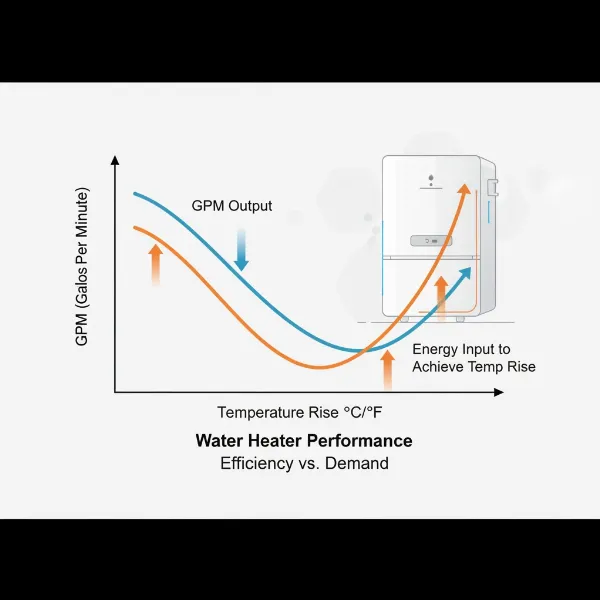 Illustration showing the inverse relationship between GPM and temperature rise in a tankless water heater, with two lines crossing on a graph.
Sizing Your Water Heater: Balancing GPM and Temperature Rise
Properly sizing a water heater, especially a tankless model, is not guesswork—it’s a precise process of balancing your household’s hot water demands with the unit’s capabilities. An undersized unit will lead to cold showers and frustration, while an oversized one is an unnecessary expense.
Here’s a practical guide to sizing your water heater:
1. Determine Your Peak Flow Rate
|
Our Picks for the Best Water Heater in 2026
As an Amazon Associate I earn from qualifying purchases.
|
||
| Num | Product | Action |
|---|---|---|
| 1 | Amazon Basics Electric Stainless Steel Kettle for Tea and Coffee, BPA-Free, Fast Boiling, Auto Shut-Off, 1.7 Liter, 1500W, Black and Silver |

|
| 2 | Chefman Electric Kettle, 1.8L 1500W, Hot Water Boiler, Removable Lid for Easy Cleaning, Auto Shut Off, Boil-Dry Protection, Stainless Steel Filter, BPA Free, Borosilicate Glass Electric Tea Kettle |
|
| 3 | Immersion Water Heater Electric, 2000W Portable Water Heater with 304 S S Guard & LCD Thermometer, Fast Heating Bucket Heater, Ideal for Small Bucket Bathtub, Small Pool, Home Camping Outdoor Use |
|
| 4 | Amazon Basics Electric Kettle with Glass Carafe for Tea and Coffee, BPA-Free, Fast Boiling, Auto Shut-Off, 1 Liter, 1500W, Glass and Steel |
|
| 5 | Amazon Basics Electric Kettle with Glass Carafe for Tea and Coffee, BPA-Free, Fast Boiling, Auto Shut-Off, 1.7 Liter, 1500W, Black and Silver |
|
| 6 | Portable Immersion Water Heater 1800W 120V, Electric Heater for Buckets, Bathtubs and Mini Pools, Submersible Design with Thermostat, Real Time Temperature Display and Dry Burn Protection |
|
| 7 | Zojirushi Micom Water Boiler and Warmer (135 oz. / 4L, Silver) |
|
| 8 | Portable Water Heater 2000W, Pool Heater - Immersion Heater with Digital Thermometer, Upgraded Magnesium Oxide Heating for Fast Heating, for Small Pools, Bathtubs, Buckets, Tanks |
|
| 9 | Cosori Electric Kettle, No Plastic Contact With Water, Wide Mouth For Easy Cleaning, Auto Shut Off, 1.7L Tea Kettle & Hot Water Boiler, Water Heater & Teapot, Borosilicate Glass, Black, 1500W |
|
| 10 | OVENTE Electric Kettle, 1.7L Fast Boiling Water Heater for Coffee or Tea, BPA Free with Water Level Gauge, Auto Shut-Off, Boil-Dry Protection, Indicator Light and Removable Filter, White KP72W |
|
Begin by identifying how much hot water you realistically need during peak usage times. List all the hot water fixtures and appliances you anticipate using simultaneously (e.g., two showers and a dishwasher). Add up their individual GPM requirements using the table above or by measuring them directly. For example, two showers (2 GPM each) + a kitchen faucet (1.5 GPM) would require a peak flow rate of 5.5 GPM.
2. Calculate Your Maximum Temperature Rise
Next, determine the highest temperature rise your water heater will need to achieve. This involves:
- Desired Hot Water Temperature: Usually 120°F for most households.
- Coldest Incoming Water Temperature: This is crucial. Use a local utility report or a groundwater temperature map for your region during the coldest months. If unknown, assume 50°F as a safe estimate, but colder areas might drop into the 30s. Subtract the coldest incoming water temperature from your desired output temperature to get your maximum temperature rise. (e.g., 120°F – 40°F = 80°F temperature rise).
3. Consult Manufacturer Charts
Once you have your peak GPM and maximum temperature rise, compare these figures against manufacturer specification charts. These charts typically show the maximum GPM a specific model can deliver at various temperature rises. Choose a unit that can meet or exceed both your calculated GPM and temperature rise requirements during the coldest part of the year.
The consequences of improper sizing can range from annoying to costly. An undersized tankless unit simply won’t keep up, leaving you with insufficient hot water. An oversized unit, while providing ample hot water, means you’ve paid more upfront for capacity you don’t fully utilize.
Gas vs. Electric Water Heaters: Performance in GPM and Temperature Rise
The type of fuel your water heater uses—gas or electric—significantly impacts its capabilities regarding flow rate and temperature rise.
Gas Tankless Water Heaters
Gas units typically have a substantial advantage in both GPM and temperature rise capabilities. They can generate a higher heating capacity (BTUs), allowing them to heat more water to a higher temperature in less time. Most gas-fired tankless heaters can deliver a temperature rise of 70°F at a flow rate of 5-8 gallons per minute, making them ideal for larger homes or colder climates where the incoming water is very cold. Their robust heating power enables them to maintain desired temperatures even when multiple fixtures are in use.
Electric Tankless Water Heaters
Electric tankless units are often more compact and easier to install since they don’t require venting. However, they generally have lower GPM outputs and struggle with significant temperature rises compared to their gas counterparts. A typical electric tankless heater might deliver a 70°F temperature rise at a flow rate of only 2-3 gallons per minute. This makes them better suited for point-of-use applications (like a single sink) or smaller households with lower hot water demands, especially in warmer climates where the incoming water is already relatively warm. Whole-house electric tankless systems often require substantial electrical service upgrades, which can add significant cost and complexity to the installation.
Optimizing Your Water Heater’s Performance
Even with a properly sized water heater, there are ways to fine-tune its performance for maximum efficiency and comfort.
Adjusting Settings for Efficiency and Comfort
Maintaining your water heater’s temperature between 120°F and 130°F is generally recommended. This range balances comfort, minimizes the risk of scalding, and prevents bacterial growth, such as Legionella. Lowering the temperature from 140°F to 120°F can reduce heating costs by a noticeable margin.
Practical Tips for Enhanced Performance
- Decrease or Restrict Water Flow Rate: If you find your hot water isn’t quite hot enough, especially in colder months, slightly reducing the flow rate at the faucet or shower can allow the heater more time to raise the water temperature. Be mindful not to restrict it too much, as some tankless units require a minimum flow to activate.
- Insulate Hot Water Pipes: Insulating your hot water pipes can significantly reduce heat loss as water travels from the heater to your fixtures. This ensures hotter water reaches your tap faster and reduces energy waste.
- Install a Preheater: In areas with extremely cold incoming water, a preheater can be installed to slightly raise the water temperature before it enters the main tankless unit. This effectively reduces the required temperature rise for the primary heater, allowing it to achieve higher GPM outputs.
- Consider Low-Flow Fixtures: Installing low-flow showerheads and faucets can reduce your overall GPM demand, making it easier for your water heater to maintain desired temperatures, especially when multiple fixtures are in use.
Table: Illustrative GPM vs. Temperature Rise Relationship (Gas Tankless Water Heater Example)
To illustrate the inverse relationship, consider a hypothetical gas tankless water heater with a fixed heating capacity:
| Desired Temperature Rise (ΔT) | Approximate Max Flow Rate (GPM) |
|---|---|
| 30°F | 8.0 |
| 50°F | 6.5 |
| 70°F | 5.0 |
| 90°F | 3.5 |
Note: These values are illustrative and vary widely by specific model and manufacturer specifications.
This table highlights how as the demand for temperature rise increases (e.g., from 30°F to 90°F), the maximum flow rate the unit can sustain decreases, emphasizing the critical balance you must achieve.
Conclusion
The concepts of flow rate (GPM) and temperature rise are not merely technical specifications; they are the heart of your water heater’s ability to provide the comfortable, consistent hot water your household depends on. Understanding their inverse relationship, considering your local climate, and accurately assessing your peak hot water demands are crucial steps in optimizing your system. Whether you’re upgrading an old unit or troubleshooting an existing one, prioritizing this balance ensures you get the most out of your investment.
What aspects of your water heater’s performance do you find most challenging to manage in your home?
Frequently Asked Questions
How do I calculate my household’s peak GPM demand?
To calculate your peak GPM demand, list all the hot water fixtures you anticipate using simultaneously, such as a shower, dishwasher, and sink. Find the individual GPM rating for each (often 1.5-2.5 GPM for showers, 1.0-1.5 GPM for dishwashers, etc.) and add them together. This sum represents your peak hot water flow rate requirement.
What is a typical temperature rise needed for a water heater?
For most residential applications, aiming for a hot water output of 120°F is common. If your incoming cold water temperature averages 50°F, you would need a temperature rise of 70°F (120°F – 50°F). However, this can vary significantly based on your geographic location and the season, as incoming water temperatures can fluctuate.
Why does my tankless water heater provide less hot water in winter?
During winter, the incoming water temperature is significantly colder, requiring your tankless water heater to work harder to achieve your desired hot water temperature. This increased demand for temperature rise means the heater can supply hot water at a lower flow rate (GPM), resulting in less hot water available simultaneously for your fixtures.
Can I increase my tankless water heater’s GPM output?
Increasing a tankless water heater’s inherent GPM output is generally not possible without replacing the unit with a higher-capacity model. However, you can optimize its effective GPM by reducing the required temperature rise (e.g., through a preheater), insulating hot water pipes, or installing low-flow fixtures to lessen overall demand.
Is a gas or electric tankless water heater better for high GPM needs?
For households with high GPM demands and significant temperature rise requirements, particularly in colder climates, a gas tankless Water Heater is generally superior. Gas units typically offer much higher heating capacities (BTUs), allowing them to produce more hot water at higher flow rates compared to electric models.